
This Opera Cake recipe is specifically designed for home bakers - breaking each element down into simple, manageable steps so you can confidently make this showstopping French dessert at home.
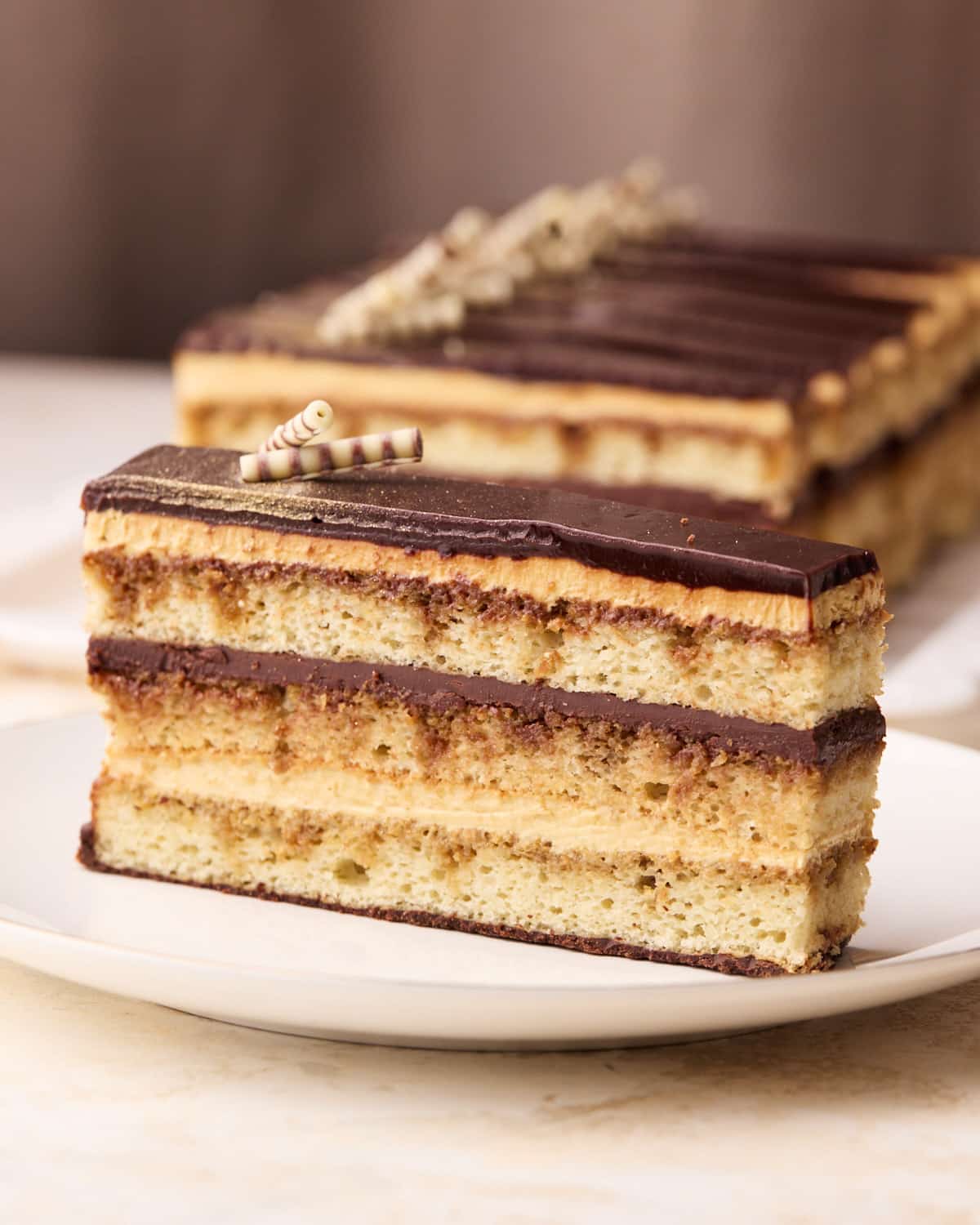
Opera Cake Recipe Snapshot
What it is: A classic French layered cake with coffee-soaked joconde sponge, coffee buttercream, and chocolate ganache.
Why you'll love it: Each component is broken down step-by-step in manageable sections with pastry chef tips.
How to make it: Bake the sponge cake, cut it into rectangles, soak with coffee, then stack it with buttercream and ganache, and slice.
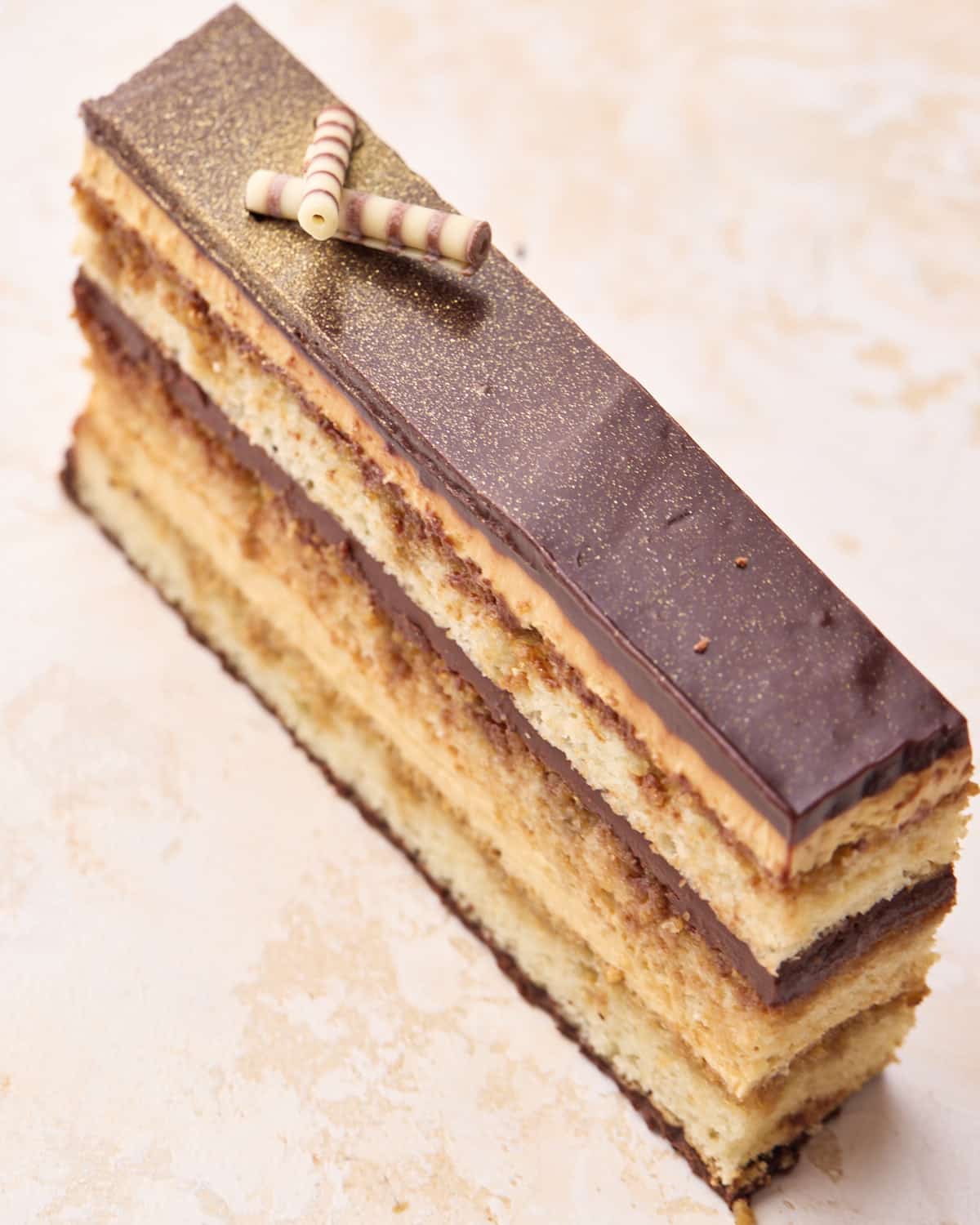
Opera cake might look like something only a professional pastry chef could pull off - but I promise you can absolutely make it at home.
A lot of Opera cake recipes are vague or skip important details, assuming you already have years of baking experience. That's what makes those clean, precise layers of almond sponge, coffee buttercream, and glossy chocolate ganache feel so intimidating.
In reality, it's just four simple components, made one at a time and then stacked together. Once you break it down like this, you'll realise it's completely achievable at home - and absolutely worth the effort.
I'm going to walk you through every step - let's do it!
What is Opera Cake?
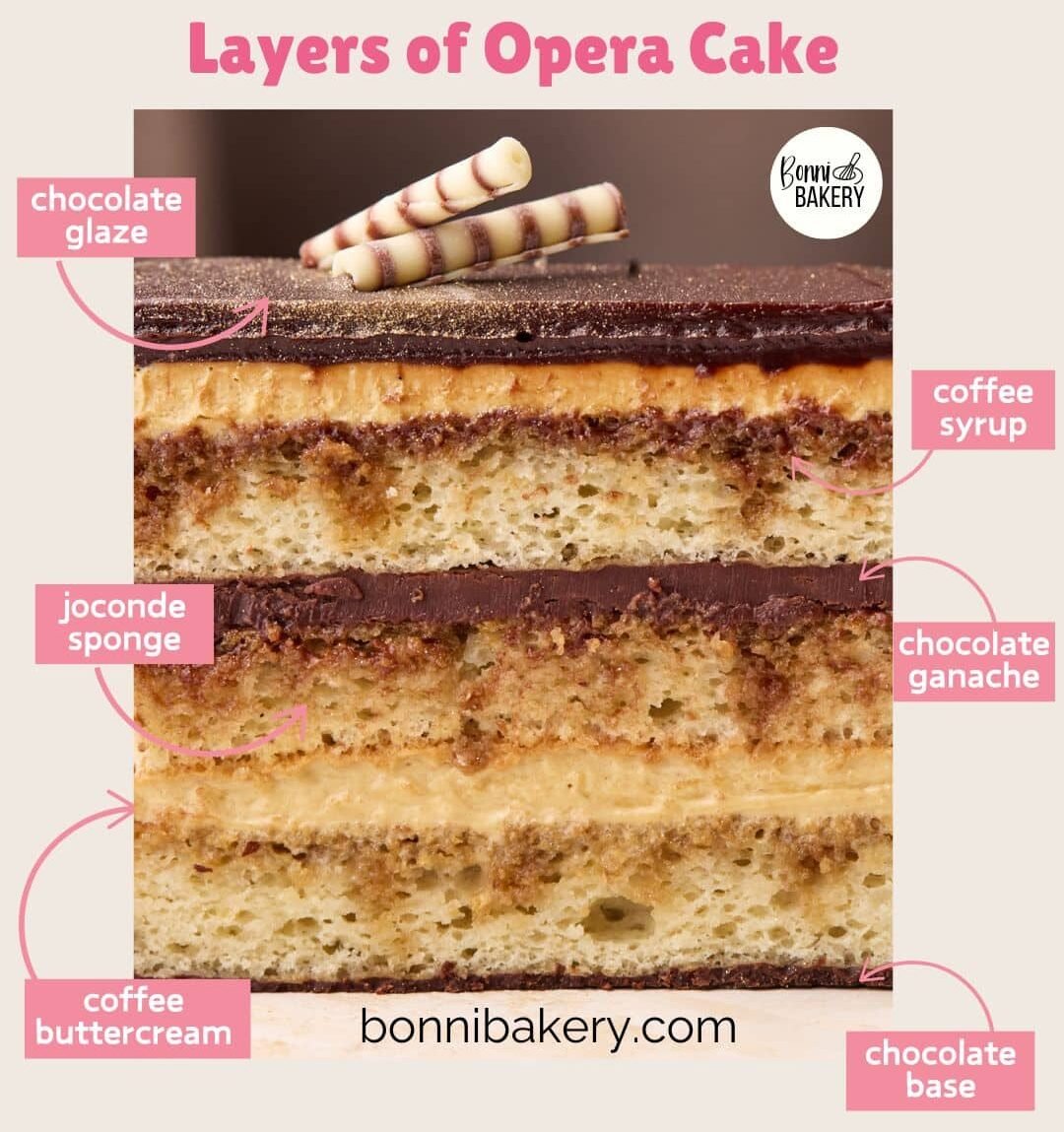
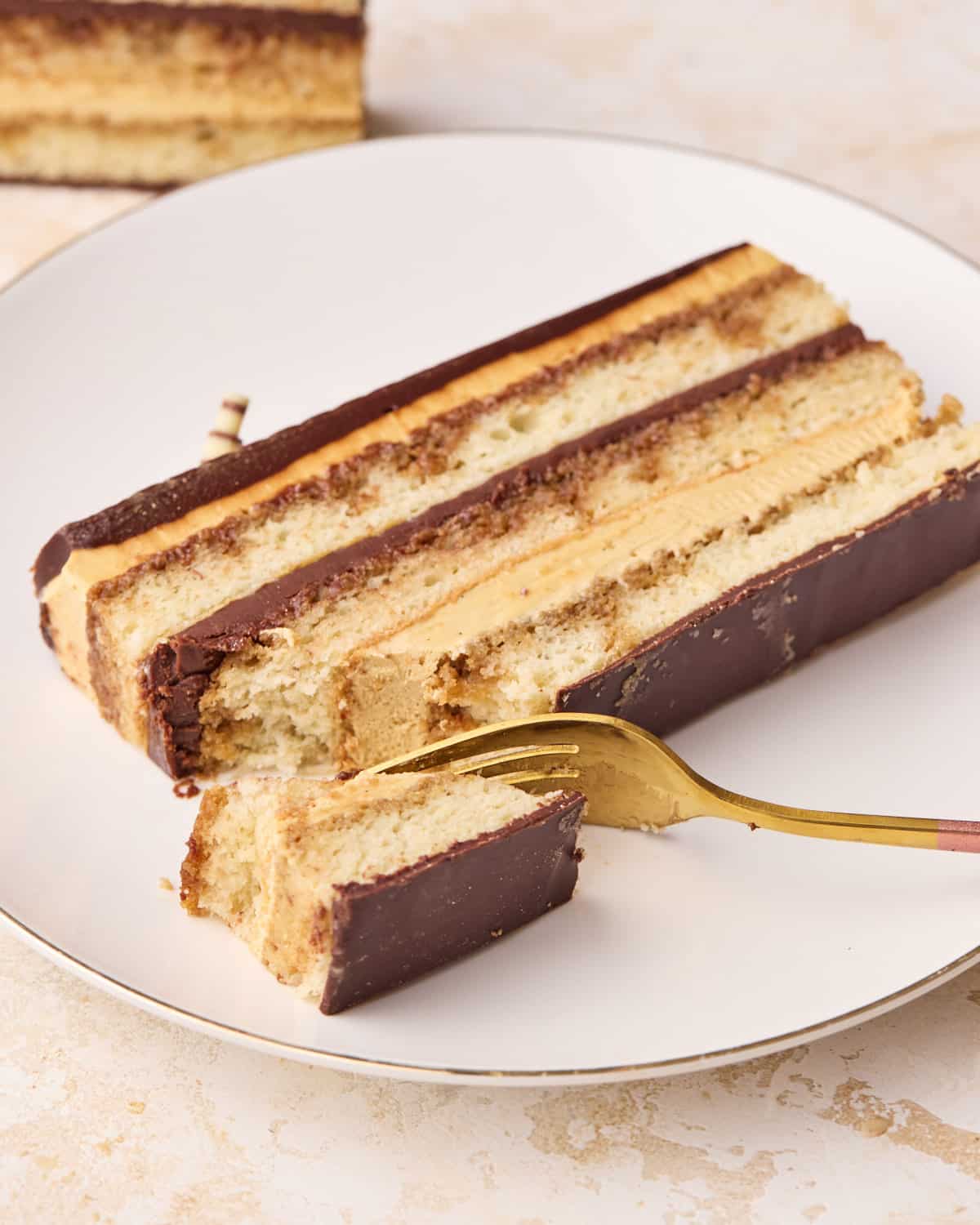
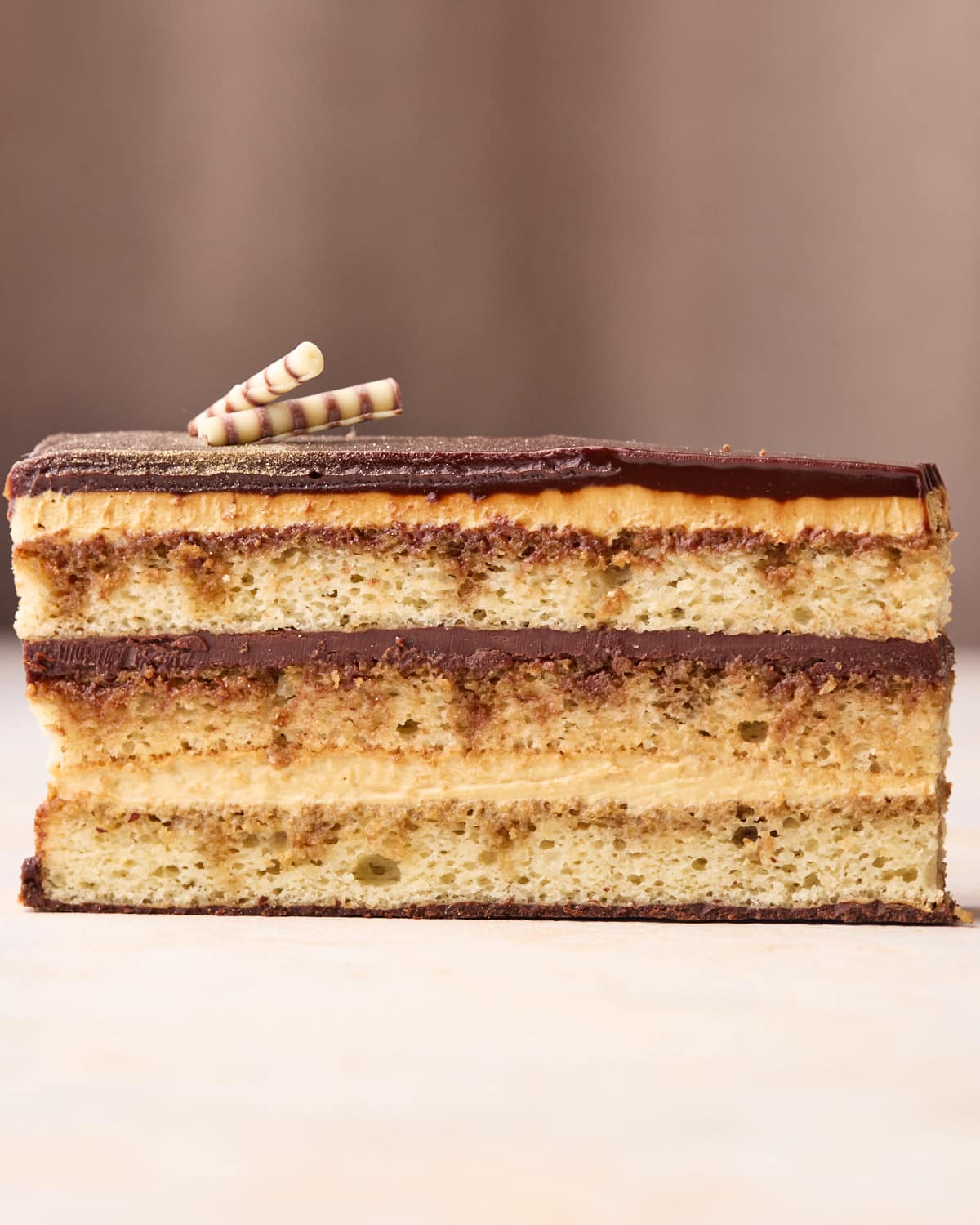
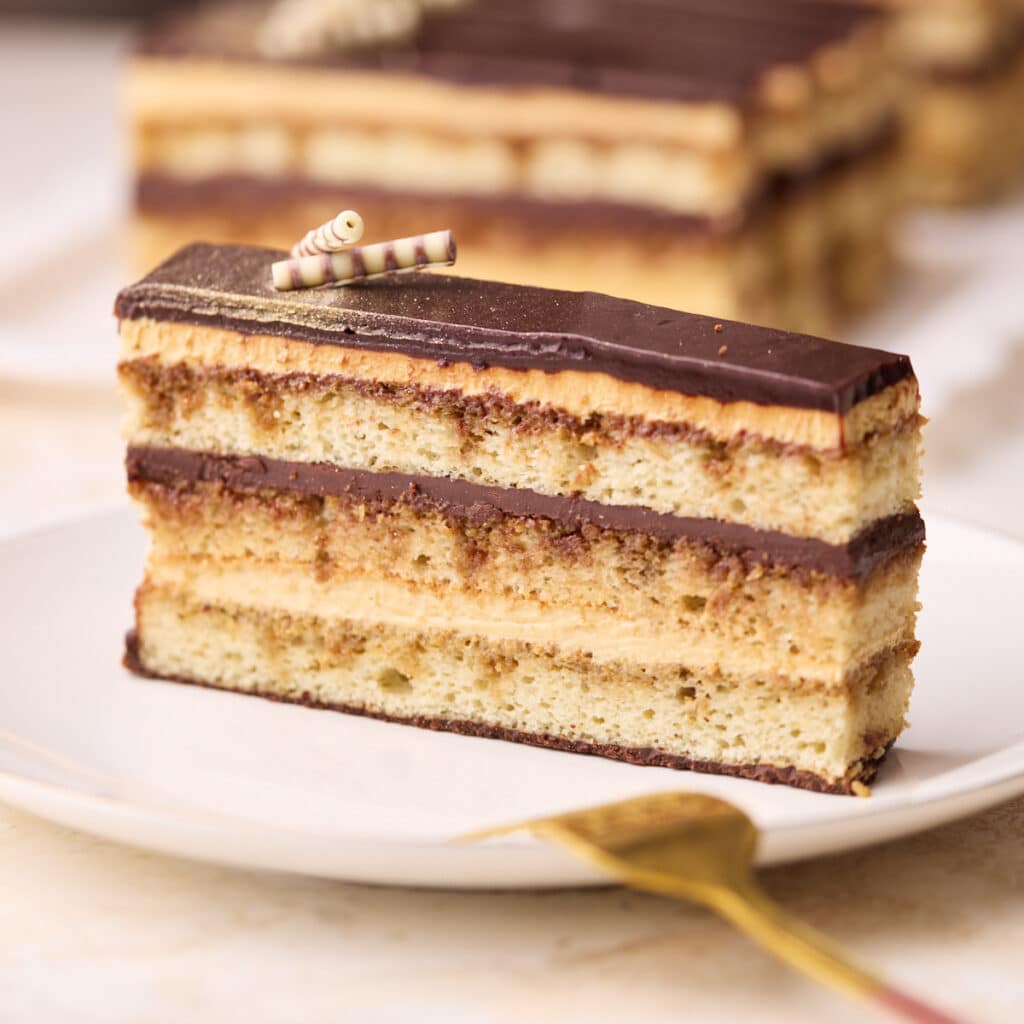
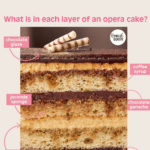
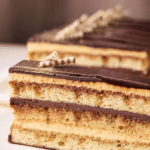
Opéra cake is a stunning French dessert consisting of layers of almond sponge cake (joconde sponge), soaked in coffee syrup and filled with coffee-flavored French buttercream and rich chocolate ganache.
This image shows you exactly what each layer is and how they come together:

Love the combination of coffee and chocolate but want something less involved? My rich chocolate espresso cake gives you both flavours in a simpler, round layer cake.
Before You Start
Opera Cake is made up of four simple components:
- Joconde sponge
- Coffee syrup
- Chocolate ganache
- Coffee buttercream
You can make some elements ahead of time, and I'll guide you through the best order to keep things manageable.
I strongly advise you to:
- Read through the whole recipe before beginning so you know what to expect.
- Use a kitchen scale to weigh your ingredients - this kind of recipe needs accuracy.
- Allow plenty of time to make this so you don't have to rush it.
Reader Review:
I tried this recipe yesterday and I must say that it is absolutely delicious!
I really like how you have laid out the steps in the recipe and include a reference to the relevant ingredients and corresponding measures for each step. Clear and easy to follow!
⭐⭐⭐⭐⭐ - Thomas
Jump to:
Ingredients
Though this classic French cake consists of many different elements, the ingredients list is fairly simple, as many of them are used in multiple layers.
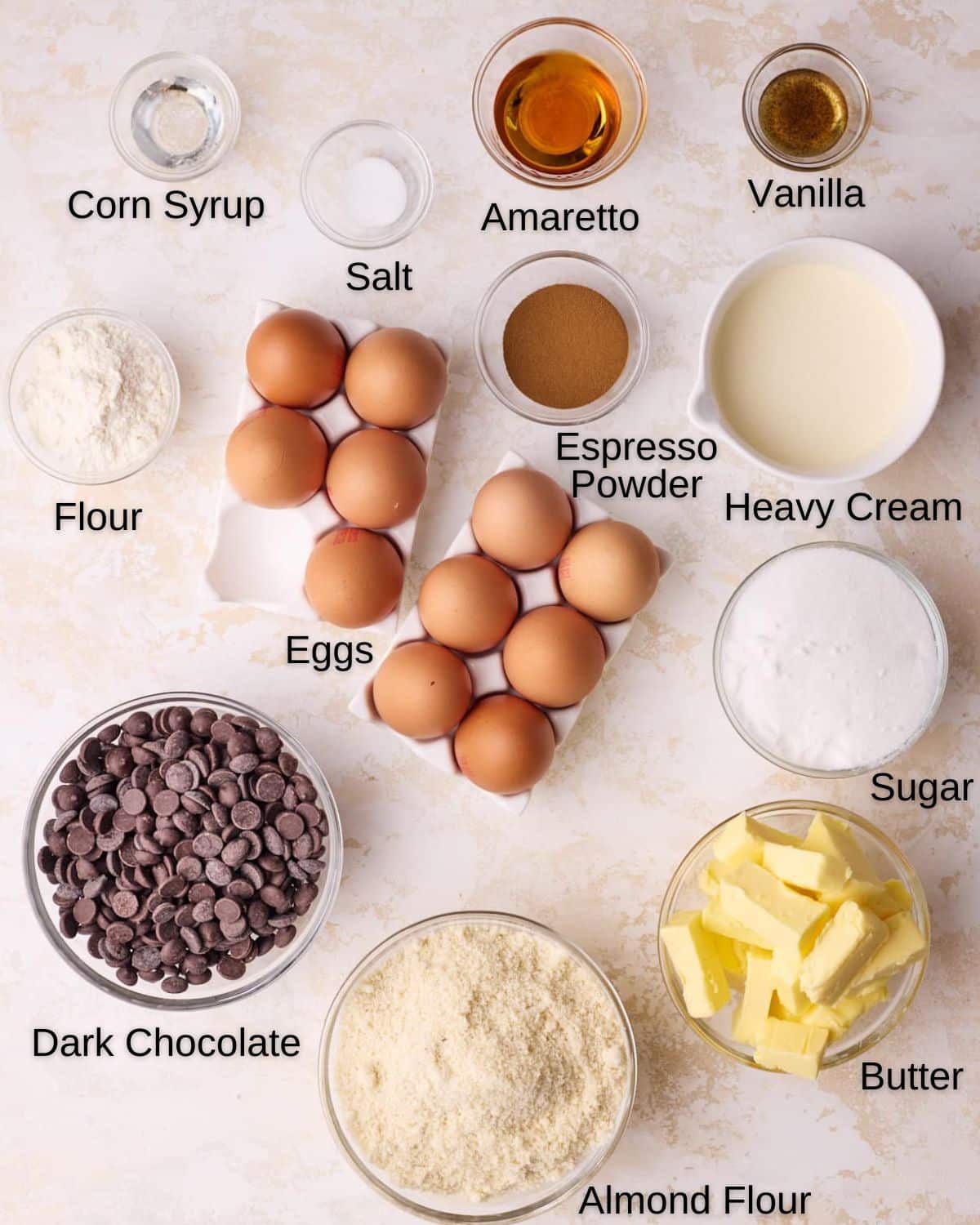
- Eggs - For the sponge cake and buttercream. Use large eggs in the US or medium eggs in the UK.
- White Sugar - Granulated sugar (caster sugar in the UK).
- Almond Flour - Look for almond flour or ground almonds, not almond meal.
- Flour - Cake flour makes a lighter sponge, but all-purpose flour (plain flour) will also work.
- Unsalted Butter - Butter is used in almost every element of this opera cake! Pay attention to the required butter temperature for each component.
- Dark Chocolate - Use high-quality semi-sweet or dark chocolate, and make sure it is real chocolate, not a candy bar or chocolate chips (unless they are couverture).
- Heavy Cream - Use heavy whipping cream or double cream; it must have at least 36% fat content, or the ganache won't set properly.
- Vanilla - Vanilla extract or vanilla bean paste balances out the coffee in the buttercream.
- Espresso Powder - The best way to get a strong coffee flavor in desserts without affecting the texture is with instant espresso powder (not regular instant coffee granules).
- Amaretto (optional) - I like to add a dash of amaretto to my coffee syrup to give it an extra kick. You can substitute with rum or brandy, or leave it out entirely and replace the liquid with water or more coffee.
- Corn Syrup - Gives the glaze a gorgeous shine. You can also use liquid glucose. No need to substitute if you leave it out.
See the recipe card for measurements in both grams and cups (but I strongly recommend weighing your ingredients with a kitchen scale).
Things You'll Need
Don't let anyone fool you into thinking you need a special cake ring and acetate to make an Opera cake! That is totally unnecessary, and I would argue actually makes it harder to spread your fillings and see if they are level.
- Stand Mixer - with whisk attachment
- Medium Saucepan
- Thermometer
- Baking Sheet - This recipe is developed for a half-sheet pan size (18 x 13 inches), but you can also use other sizes of cake pans and cut the sponge later.
- Pastry Brush
- Rubber Spatula
- Small Offset Spatula
- Plastic Tray - or cookie sheet - to easily move the cake in and out of the fridge as you build the layers.
- Long Serrated Knife - easiest for slicing, but a long sharp knife works too.
How To Make Opera Cake
The process for making an Opera cake might seem a little daunting at first, but when you make each component one at a time, it's actually pretty straightforward.
This is the order that I found best to make things in, but you can change it up or prepare some elements ahead of time.
Make the Chocolate Ganache
It's best to start with the ganache, so it has time to set to a spreading consistency while we make the other elements.
If this is your first time, you can get loads of helpful tips in my complete guide to chocolate ganache.
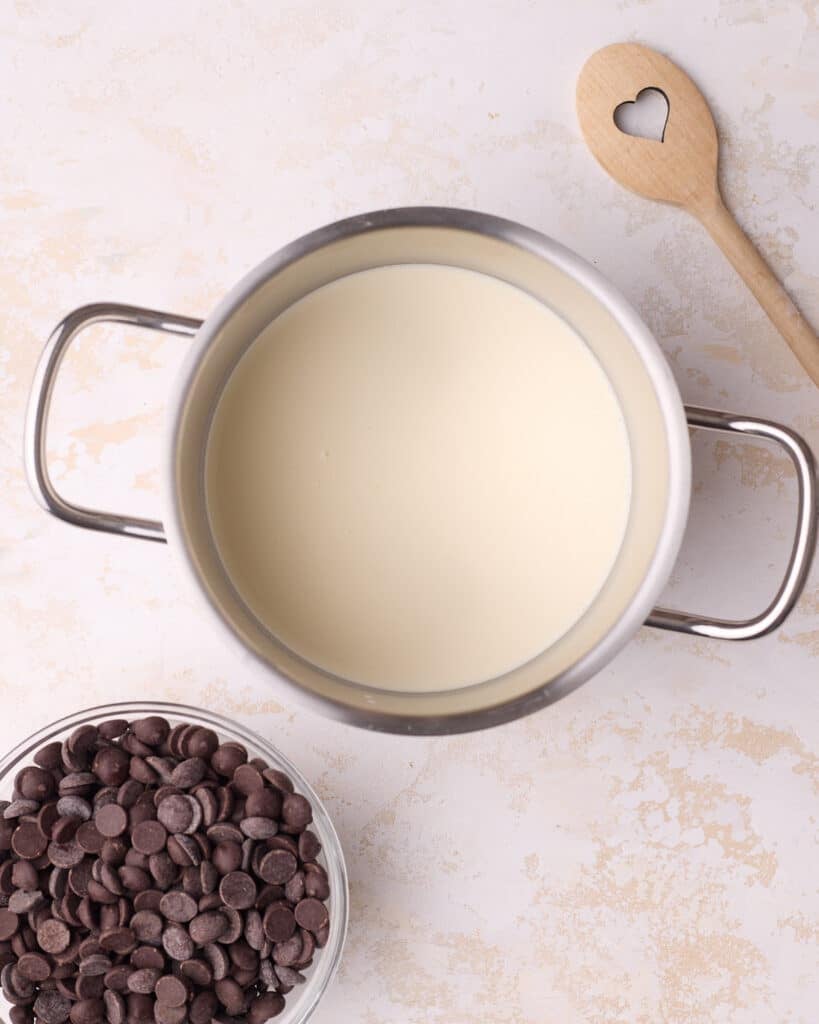
Heat the Cream
Put the chopped chocolate in a medium bowl and put the heavy cream in a small saucepan over medium heat.
Heat the cream, stirring occasionally, until it is scalding hot. This means that there is steam rising from it, and you can see tiny bubbles appearing on the surface. Don't let it boil.
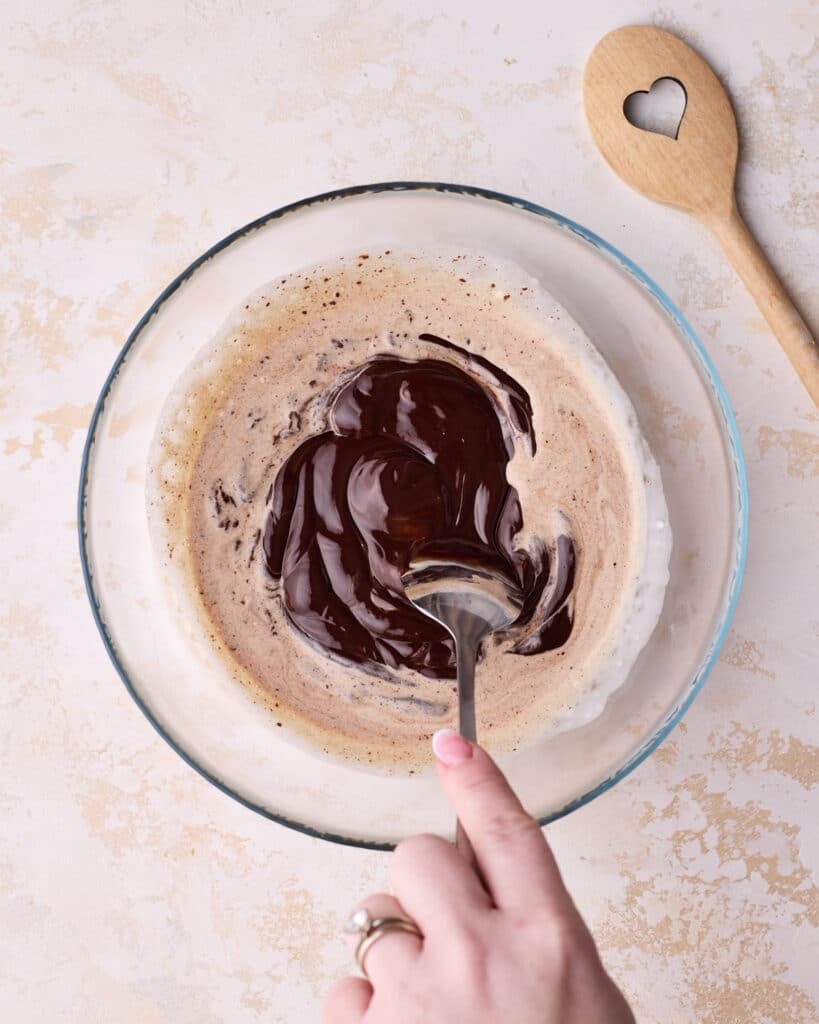
Melt the Chocolate
Pour the hot cream over the chocolate and let it sit for 1-2 minutes, then stir in circles in the middle of the bowl until it comes together into a glossy ganache and all the chocolate has melted.
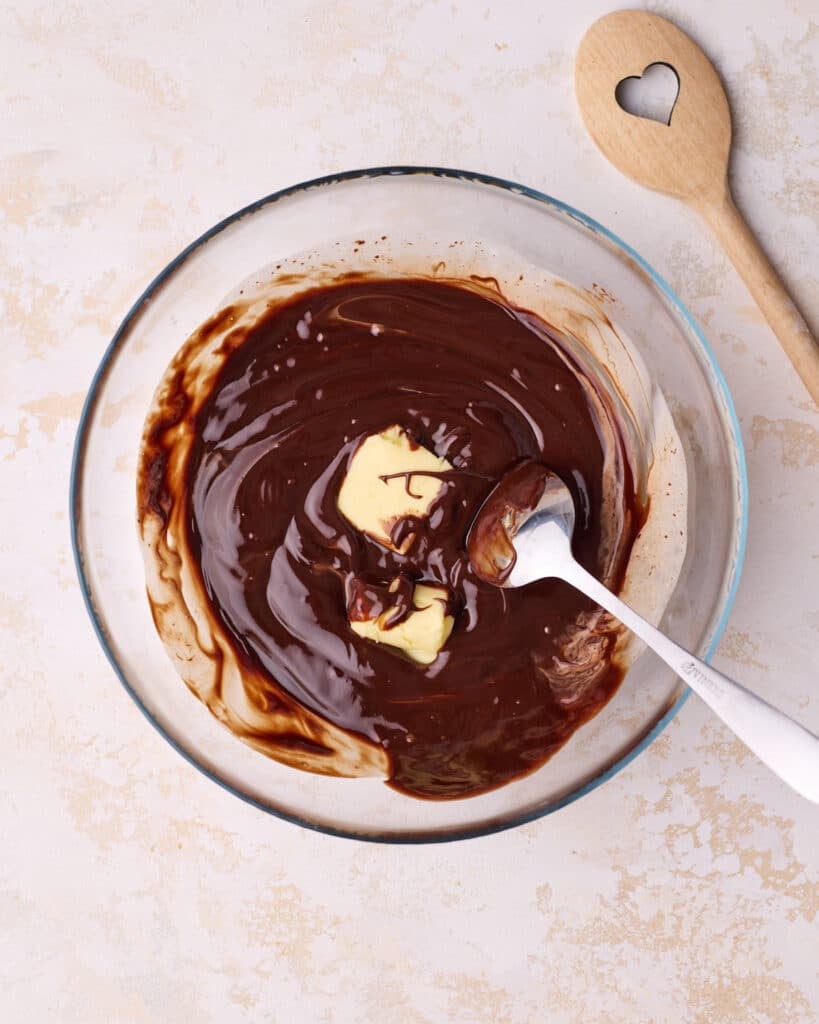
Add Butter
Stir in the room temperature butter until it has melted in completely.
Cover with plastic wrap and set aside to cool and thicken to a spreadable consistency.
How to Make Joconde Sponge
Joconde sponge is a light almond sponge cake. It uses almond flour to give it structure and flavor, so it is more flexible than a classic vanilla sponge cake and more moist than a Genoise sponge cake.
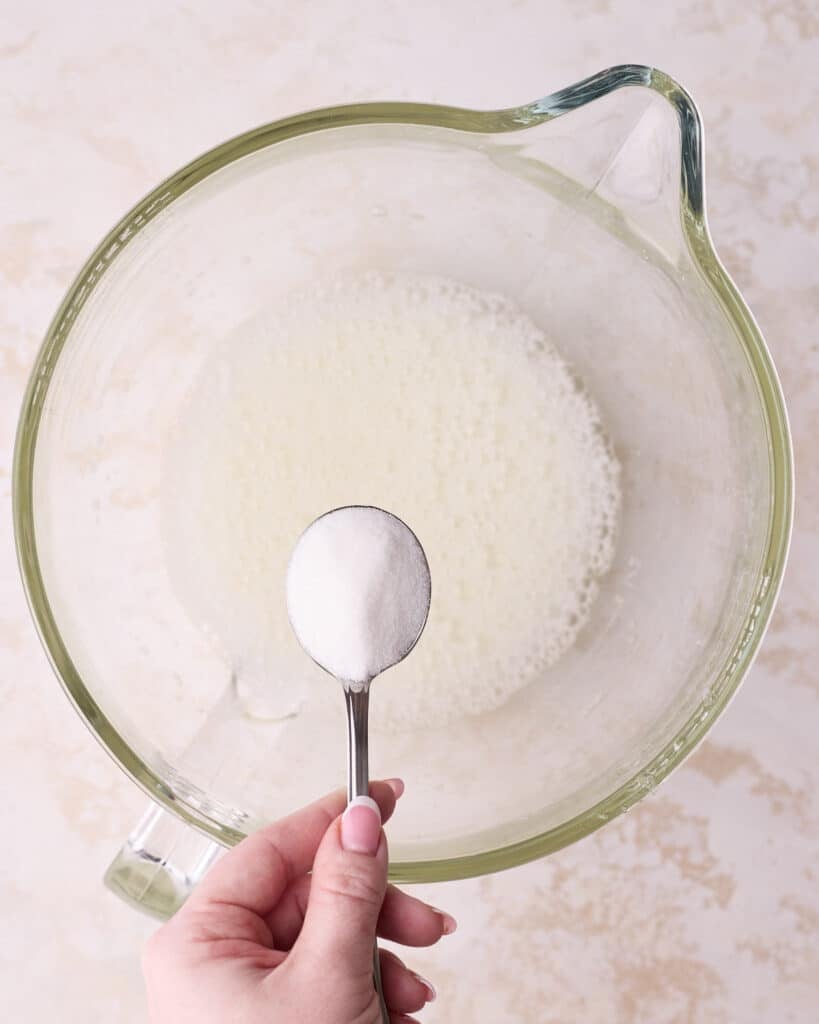
Whip Egg Whites
In the bowl of a stand mixer, whip the egg whites on high speed with the whisk attachment until they start to get frothy.
Gradually add the smaller portion of sugar, one tablespoon at a time, waiting about 15 seconds between each addition to allow the sugar to dissolve.
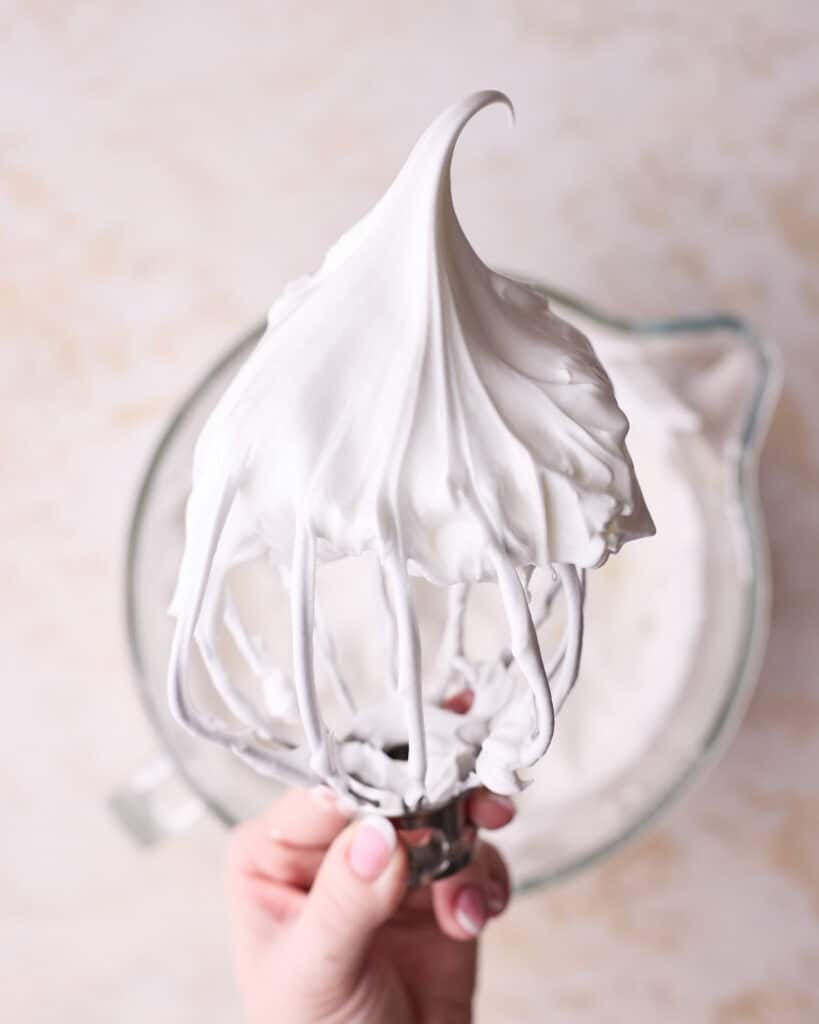
Make Meringue
Continue whipping until the meringue reaches stiff peaks (peaks are firm, but the tips curve slightly like a hook). Be careful not to overwhip.
Transfer the meringue to a separate bowl and set aside.
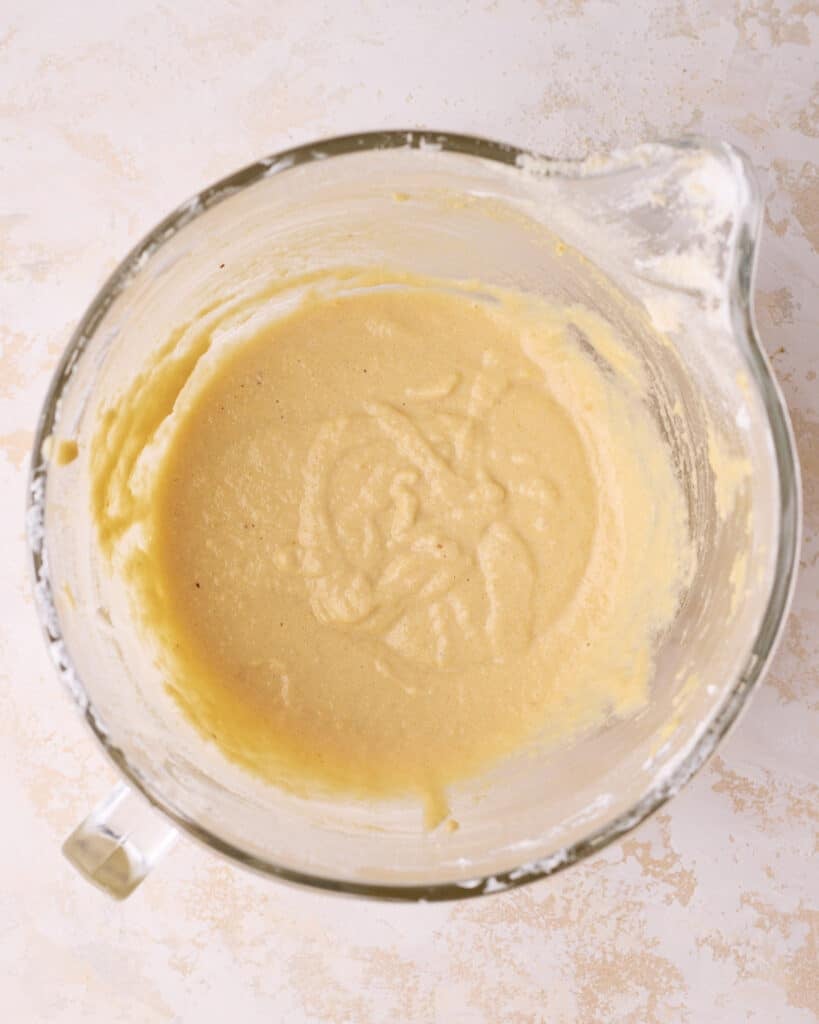
Almond Mixture
In the now-empty mixer bowl (no need to clean it), combine the 5 whole eggs, almond flour, and the remaining sugar.
Whip on high speed until the mixture reaches the ribbon stage, where it falls in a steady stream and leaves a visible pattern on the surface that disappears after a few seconds.
Fold in Meringue
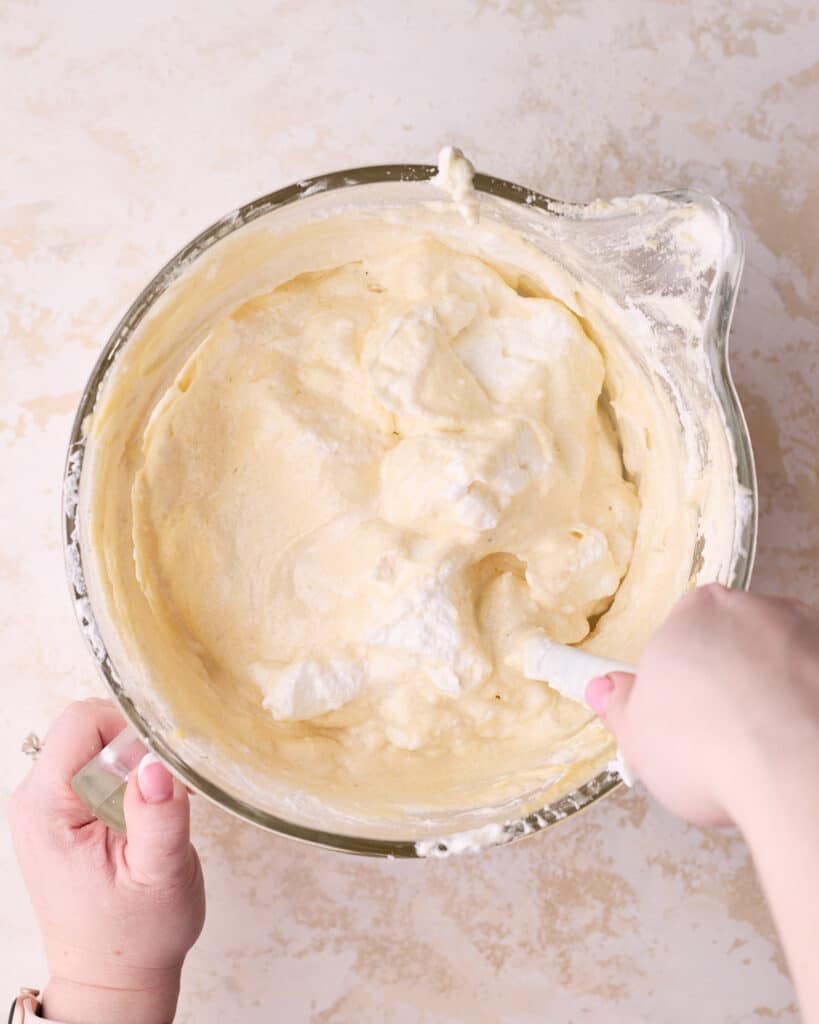
Gently fold half of the meringue into the almond mixture using a rubber spatula until it is almost incorporated but some streaks of white are still visible.
Add the remaining meringue and fold again, being careful not to deflate the batter.
Fold in Flour
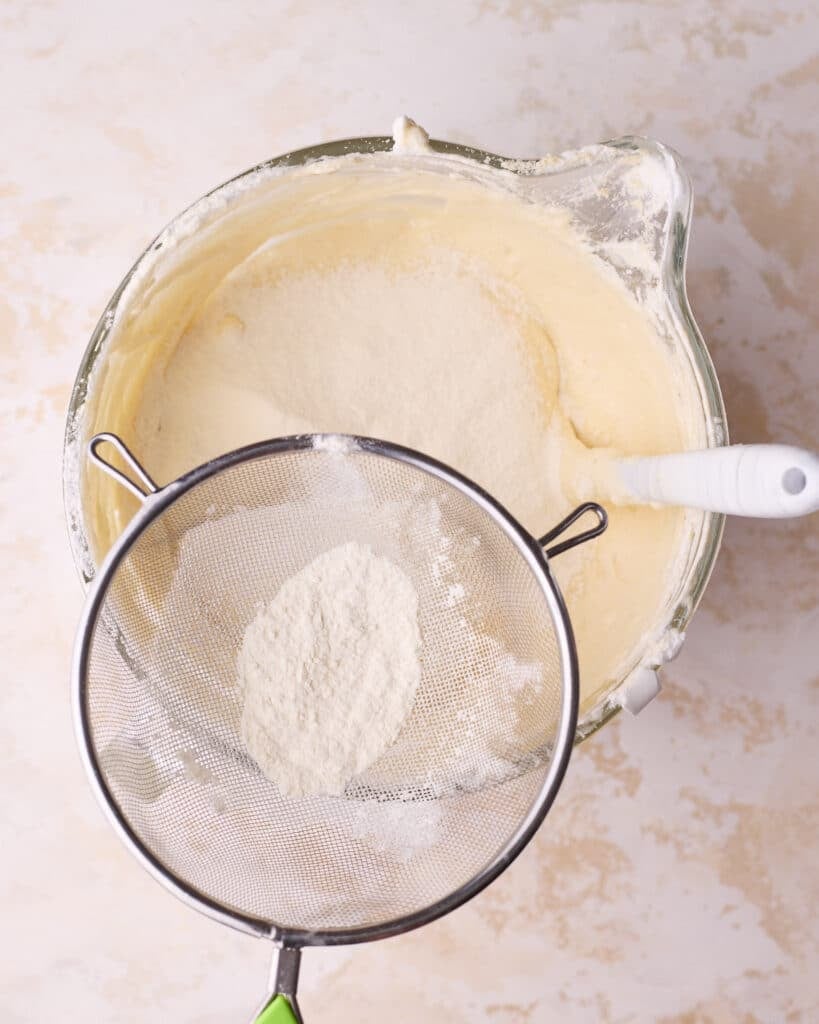
Sift the flour on top of the batter and gently fold it in until completely incorporated, ensuring no flour is left at the bottom or sides of the bowl
Add Butter
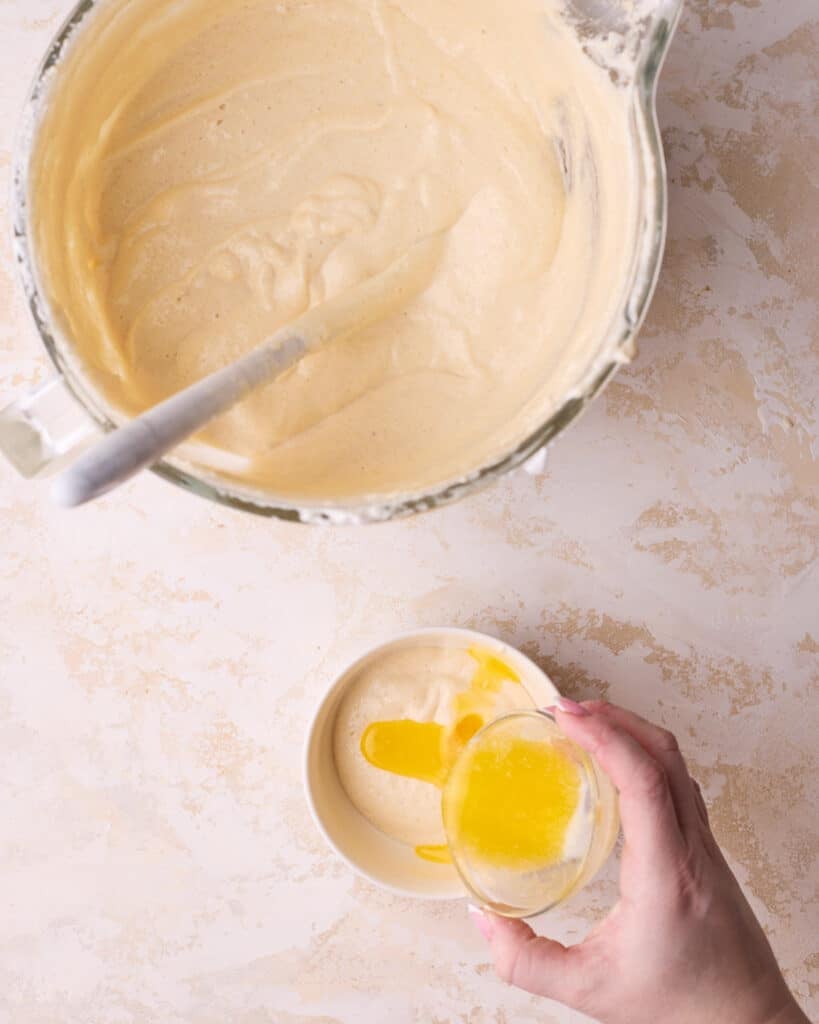
Take a small dollop of the batter and mix it thoroughly into the cooled, melted butter. This step is called "sacrificing," and it ensures the butter incorporates smoothly into the batter.
Gently fold the butter mixture back into the main batter until fully combined.
Pour into Cake Pan
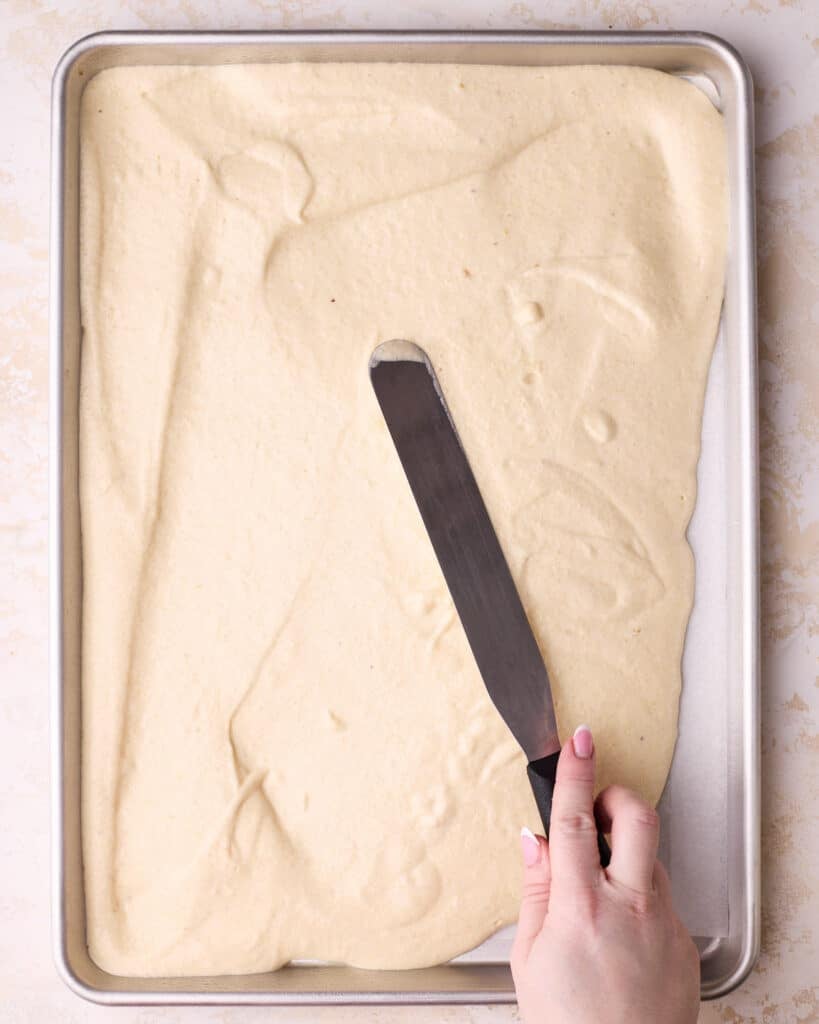
Pour the joconde batter into the prepared pan and gently spread it out to all the corners.
Use your spatula or palette knife to get the batter as level and even as possible, as it won't self-level during baking.
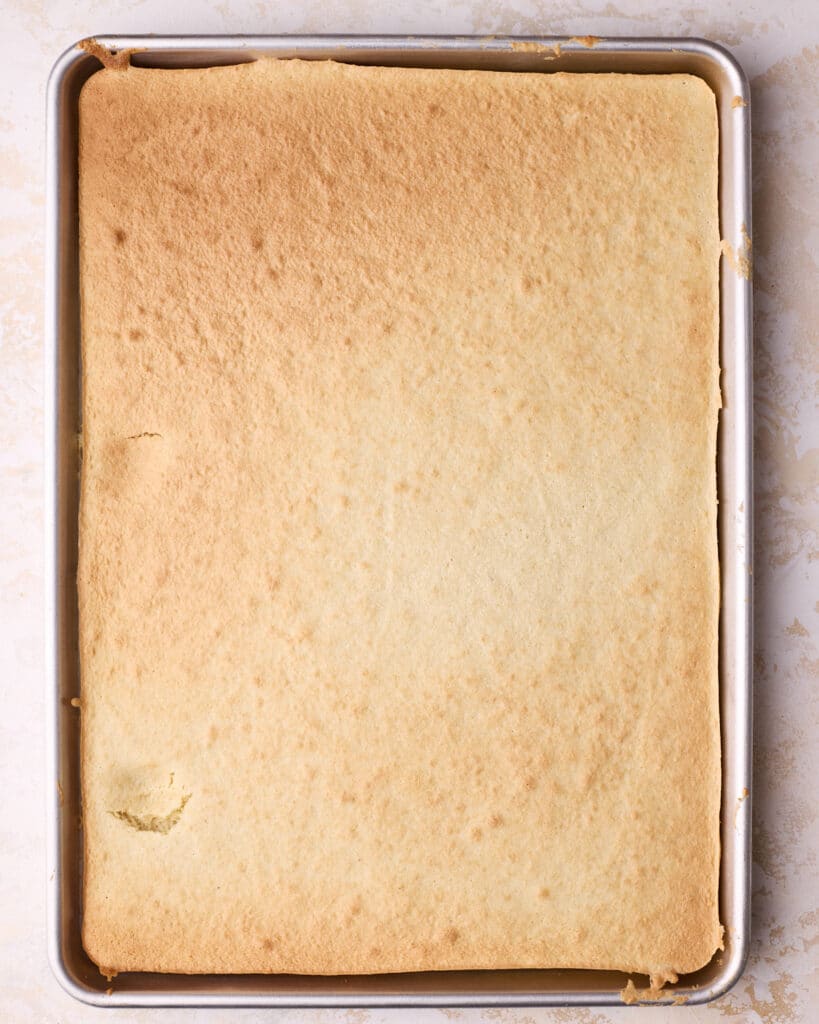
Bake
Bake in a preheated oven for 12-16 minutes, or until the sponge begins to develop a light golden color, pulls away from the edges of the pan, and springs back slightly when pressed.
Let the sponge cool completely in the pan.
Make the Coffee Syrup
The coffee soak is a coffee simple syrup; it adds moisture and flavor to the joconde sponge. Sponge cakes are naturally quite dry and are designed to soak up liquid (and flavor), so don't skip this step!
I like to add some Amaretto to my coffee syrup, but you can swap it for something else or make it without.
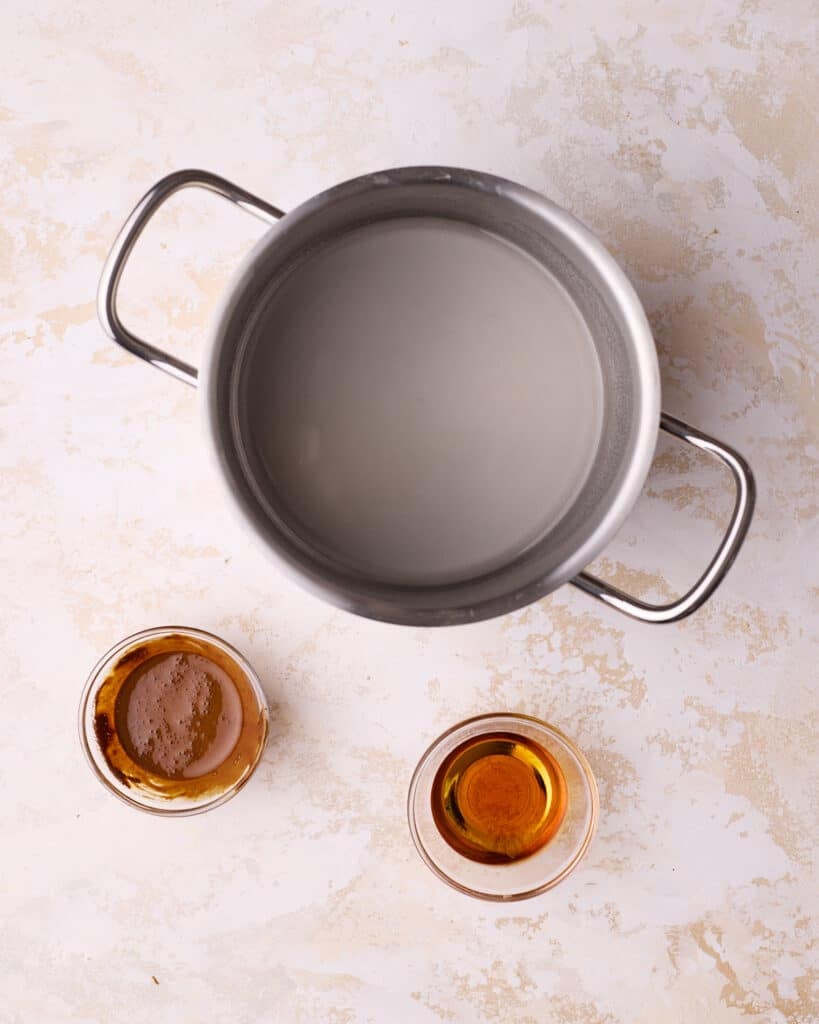
Boil Sugar and Water
Take 1 tablespoon of the water and mix it in a small bowl with the espresso powder until it dissolves.
Put the rest of the water in a small saucepan with the sugar over medium-high heat and bring to a boil until the sugar has dissolved and the liquid turns clear.
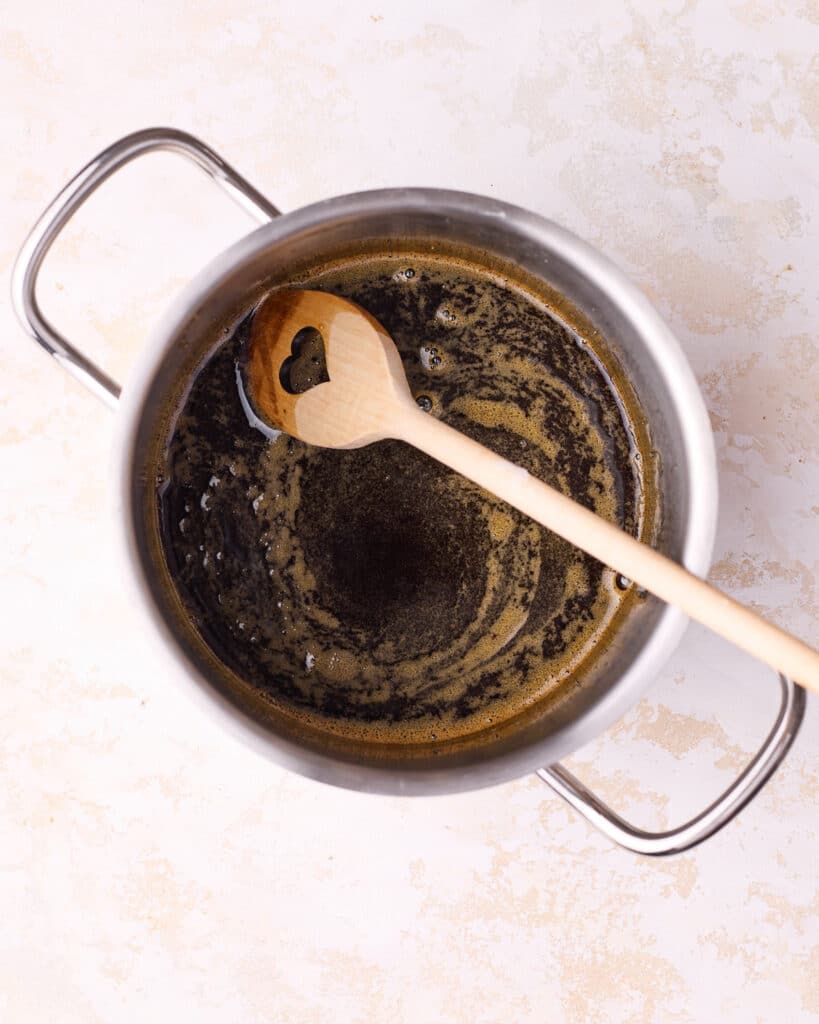
Stir in Coffee
Remove from the heat and add in the dissolved espresso and the amaretto (if you want to add it).
For a non-alcoholic version, just replace the alcohol with an equal amount of water or coffee.
Make the Coffee Buttercream
French buttercream is perfect for Opera cake because it is rich and silky, and it also uses up the leftover egg yolks from the joconde, so nothing is wasted.
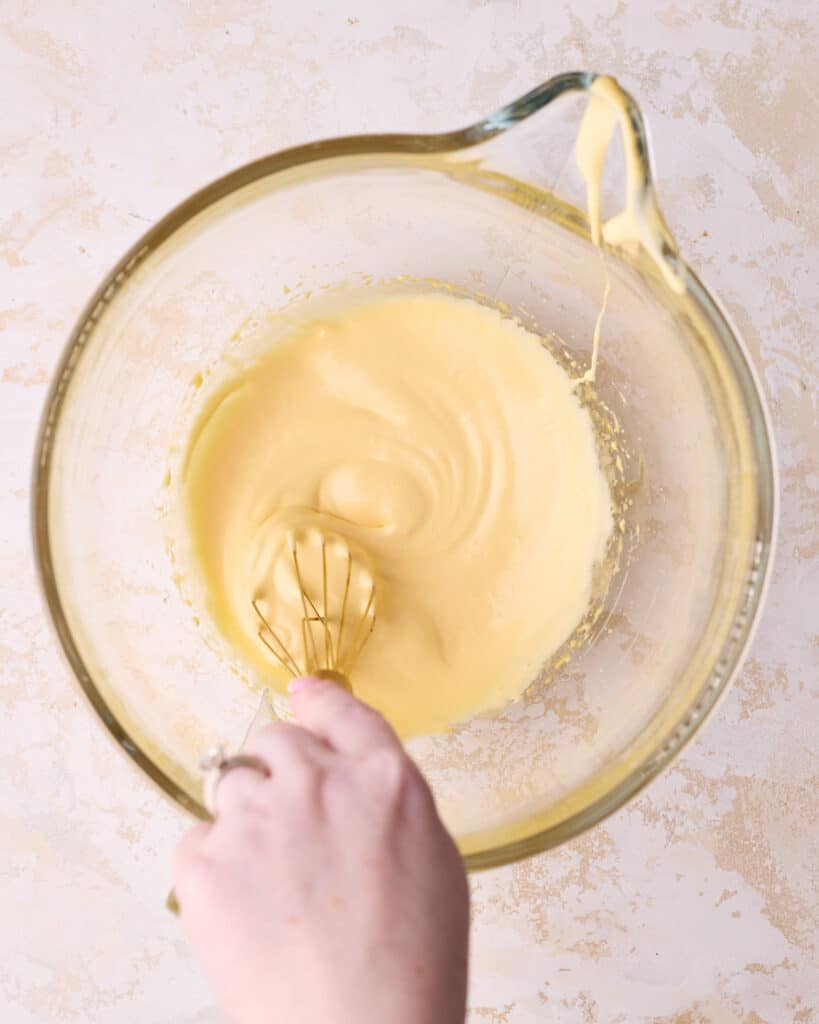
Whisk Egg Yolks
In a clean stand mixer bowl, whip the egg yolks on medium-high speed until thick and pale, about 5 minutes.
Meanwhile, make a sugar syrup by boiling the sugar and water in a small saucepan over medium heat, until it reaches exactly 240°F / 115°C.
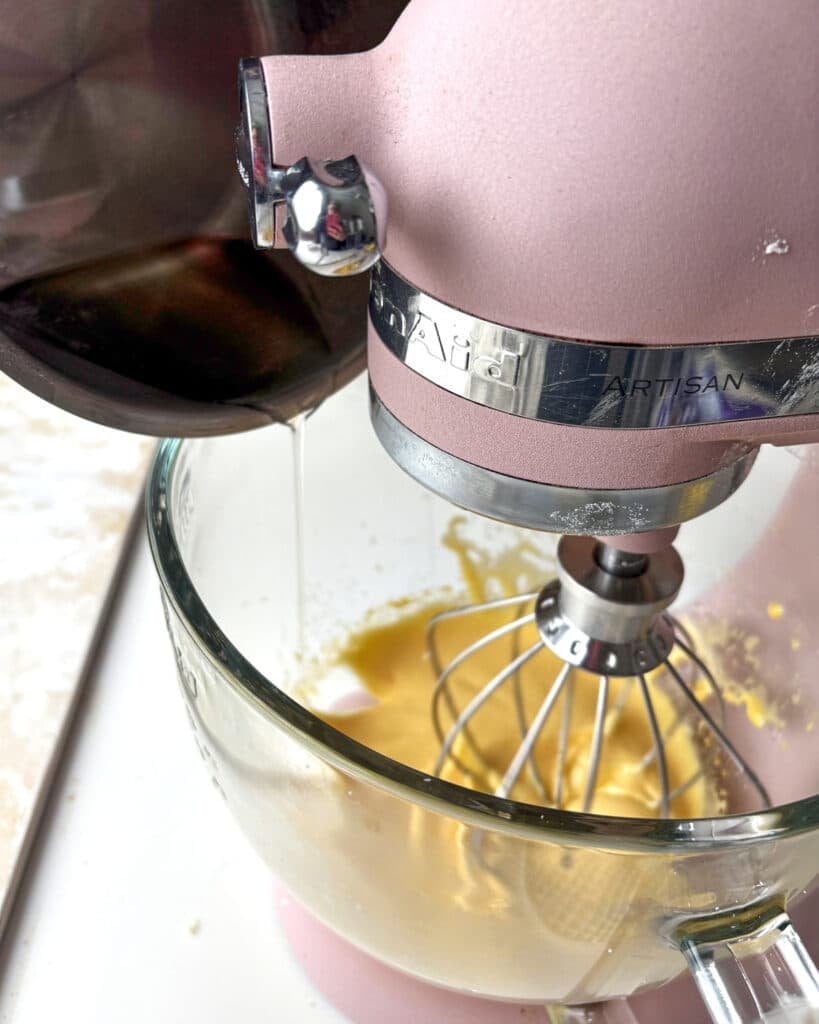
Pour in Syrup
With the mixer on low speed, slowly pour the hot sugar syrup into the egg yolks in a steady stream, avoiding the whisk to prevent splatter.
Turn the mixer up to high speed and whip until the mixture cools to room temperature, about 10 minutes.
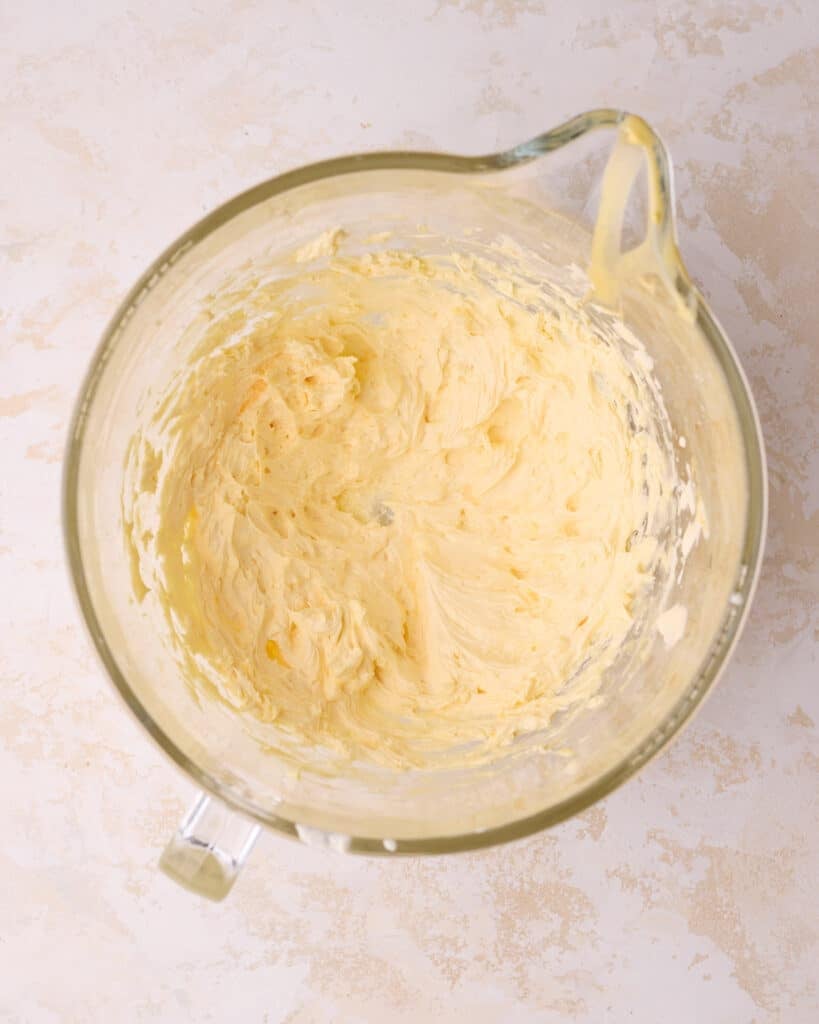
Add Butter
With the mixer still on high, add chunks of butter one at a time, allowing each to fully incorporate before adding the next.
Once all the butter is added, continue to whip for 1 minute. You should have a thick, glossy buttercream. If not, see my post about how to fix broken buttercream.
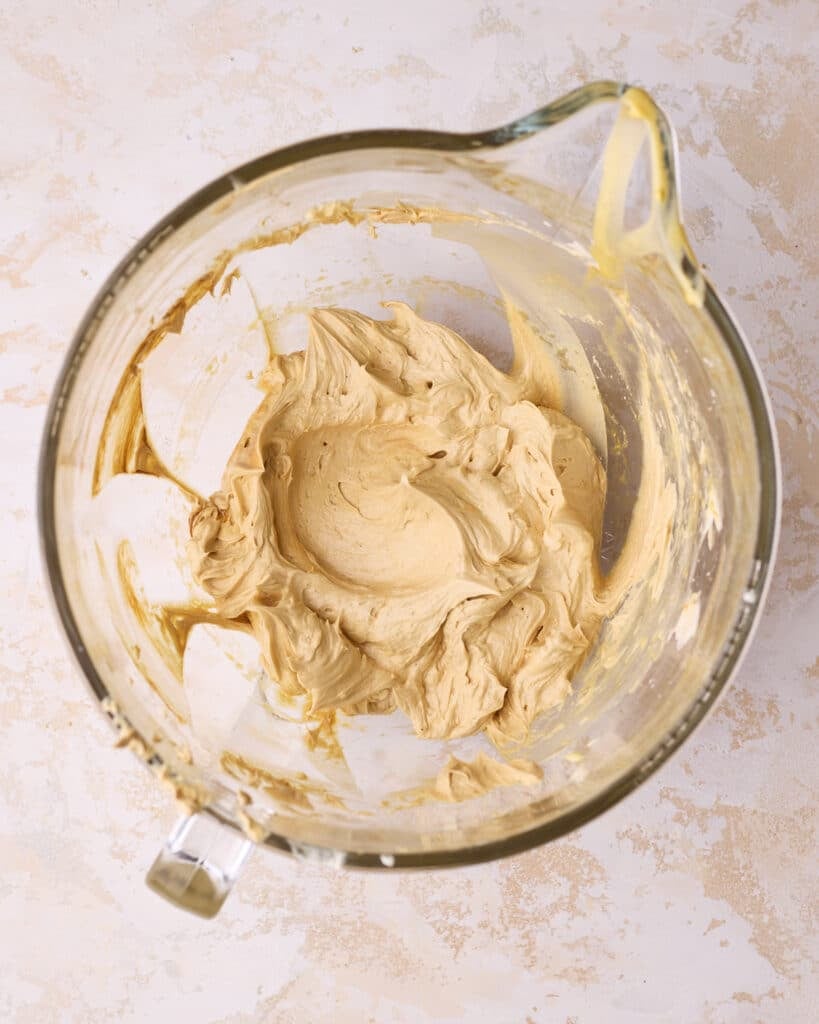
Add Coffee
Dissolve the espresso powder in a splash of hot water, then add it to the buttercream along with the vanilla and salt. Whip for 30 seconds until everything is combined and you have a silky smooth coffee buttercream.
Assemble The Opera Cake Layers
Once you have all the elements, putting the opera cake together is actually pretty straightforward, and I think quite therapeutic!
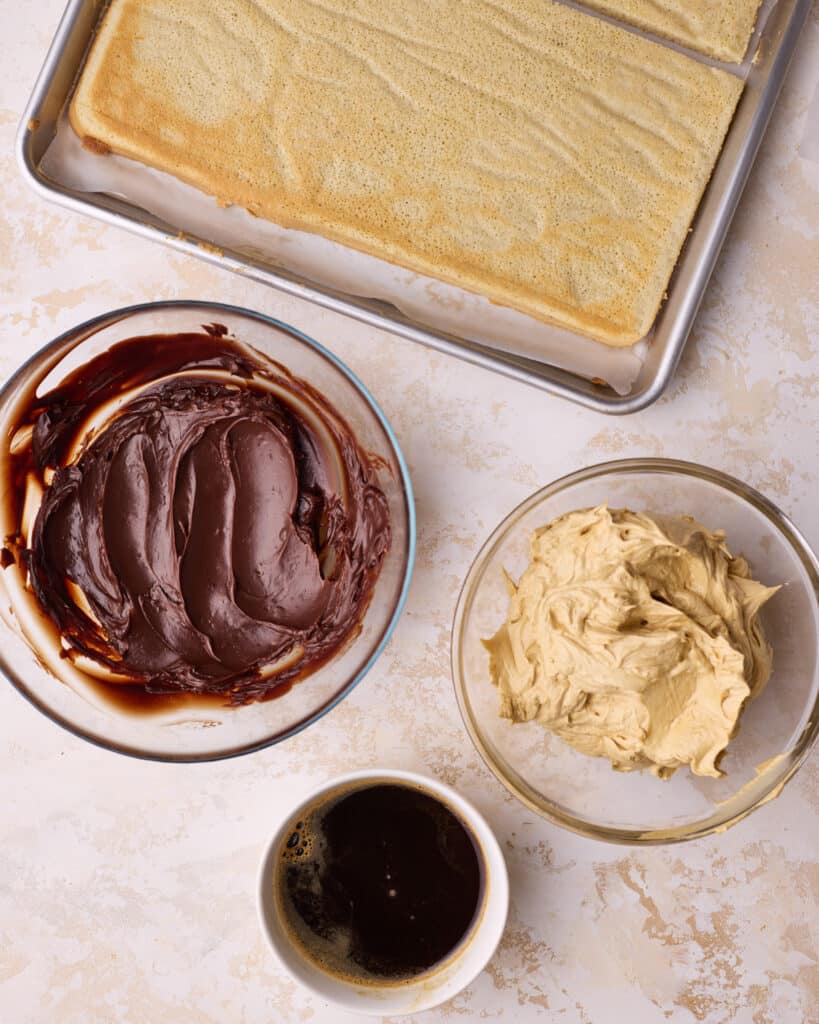
Prepare
Make sure you have all the elements ready and laid out in front of you.
Melt the dark chocolate in the microwave and mix the vegetable oil into it.
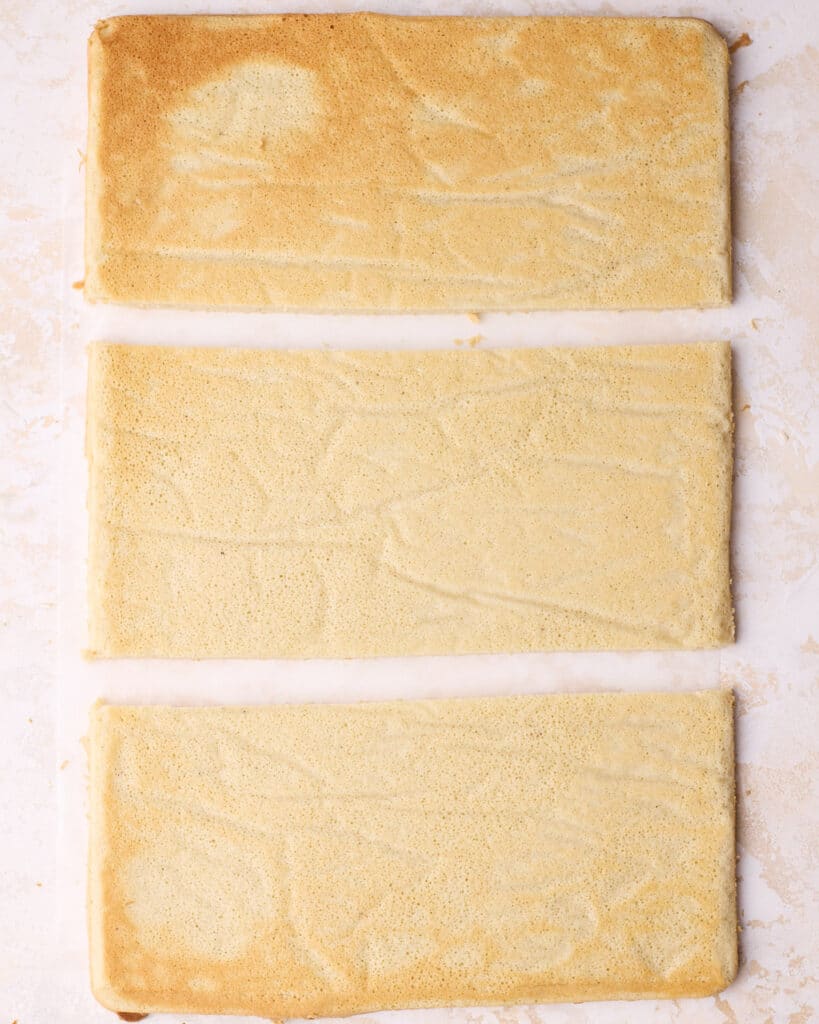
Cut Cake Layers
Use a sharp knife to cut the joconde sponge into three even rectangles.
For best results, use a measuring tape to get the whole length, divide by 3, and measure out where to make your cuts.
It doesn't matter so much what size they are, only that they are all roughly the same size.
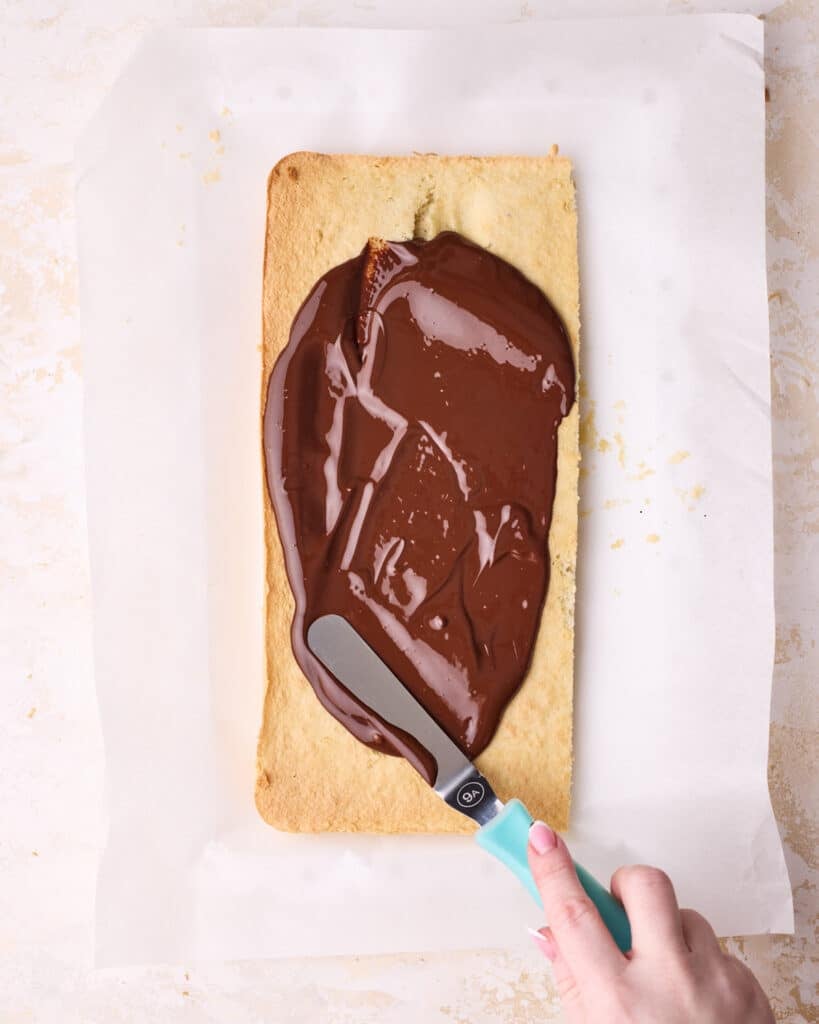
Chocolate Base
Place one of the cake layers on a separate piece of parchment paper, on the serving plate or cookie sheet.
Spread the melted chocolate on top of the cake and smooth it out. Don't worry about the edges being perfect, as we'll trim them later anyway.
Put it in the fridge to set for 5-10 minutes, until it is hard.
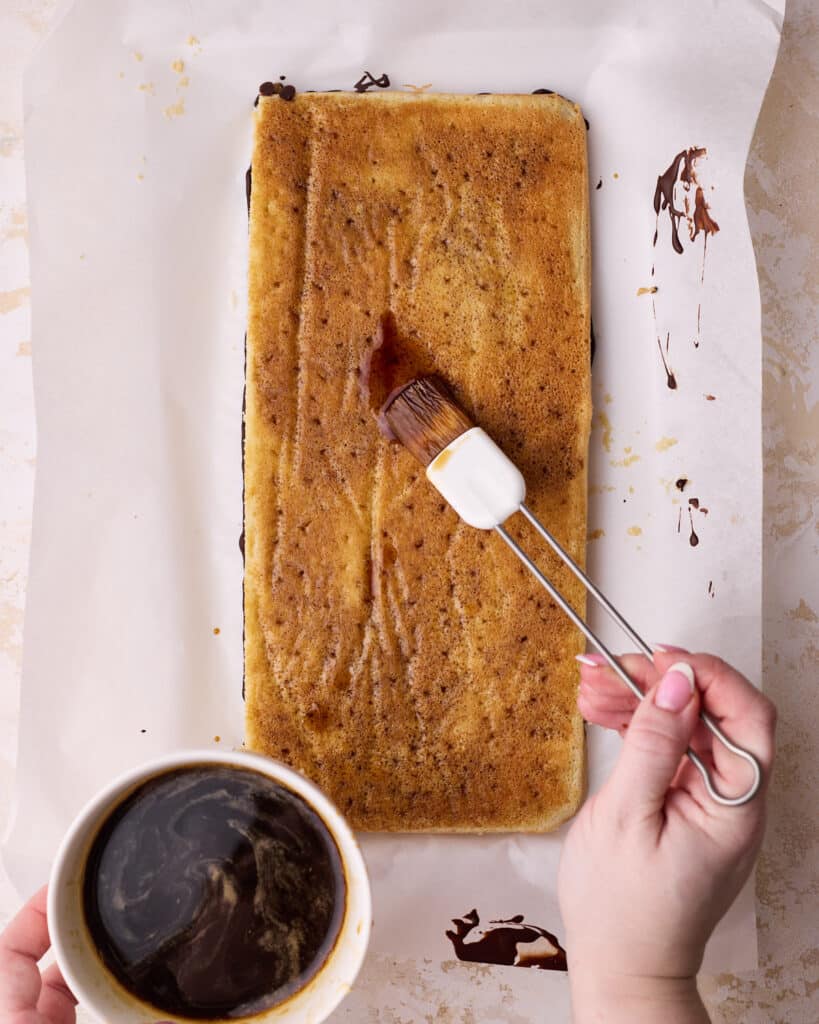
Coffee Soak
Flip the sponge over so the chocolate is on the bottom; this will be the first layer. Use a skewer to poke holes all over the top.
Brush the coffee soak all over the sponge with a pastry brush, then repeat once it has soaked in a little. Be generous with it, but don't oversaturate it or it will go soggy.
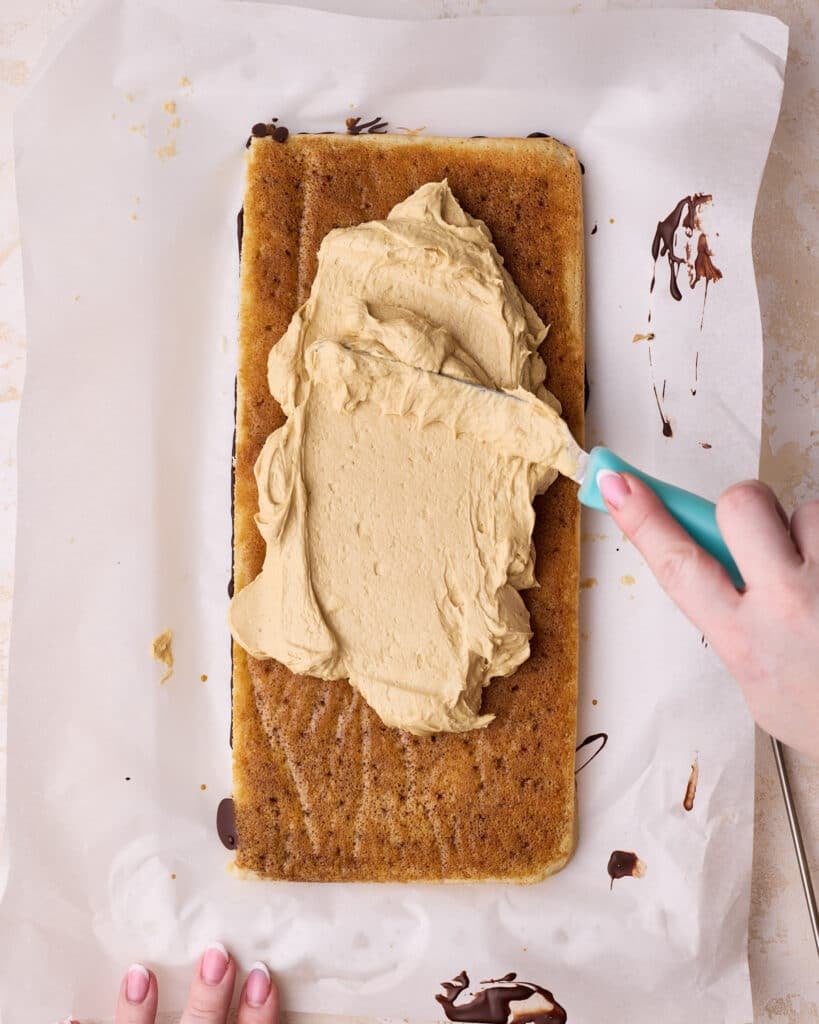
Coffee Buttercream
Put roughly half of the coffee buttercream on top of the sponge and spread it out as smoothly and evenly as possible.
Crouch down to look at the cake at eye level to check for evenness - if the layers are not even, then the finished cake won't be either.
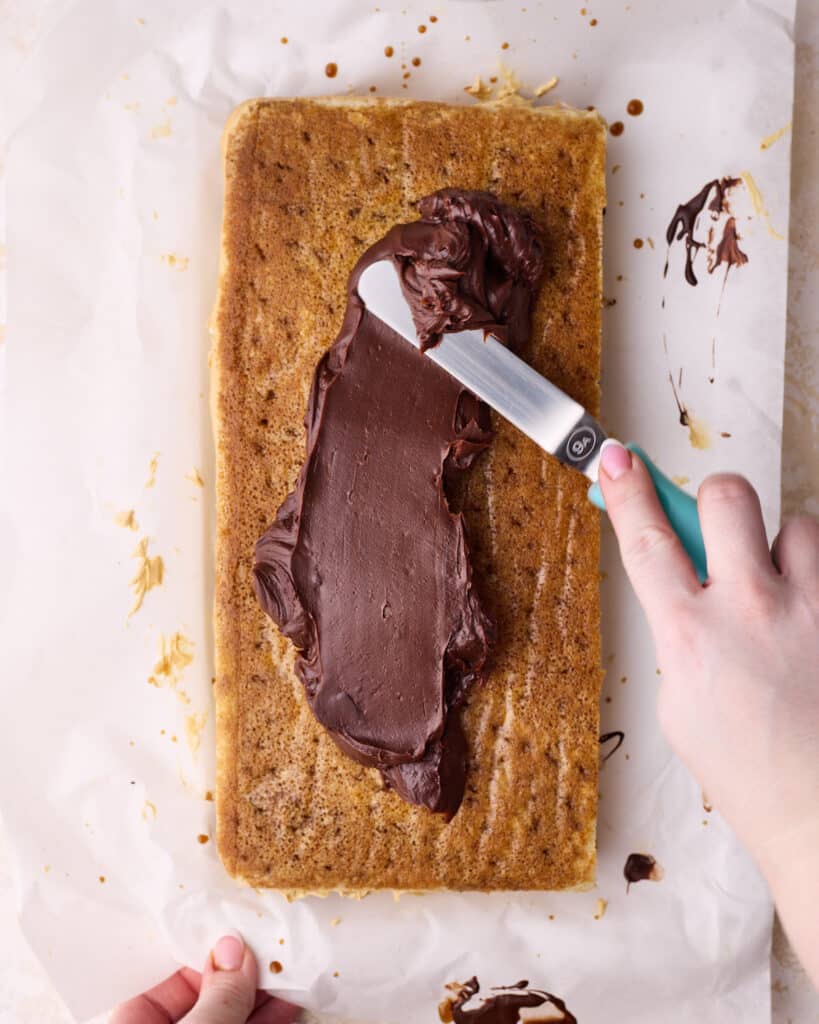
Ganache Layer
Put the next layer of joconde sponge on top and repeat the process with poking holes and soaking with syrup.
Spread all of the ganache on top of this cake layer and smooth it out.
Place the final cake layer on top of the ganache, poke holes, and soak with coffee syrup.
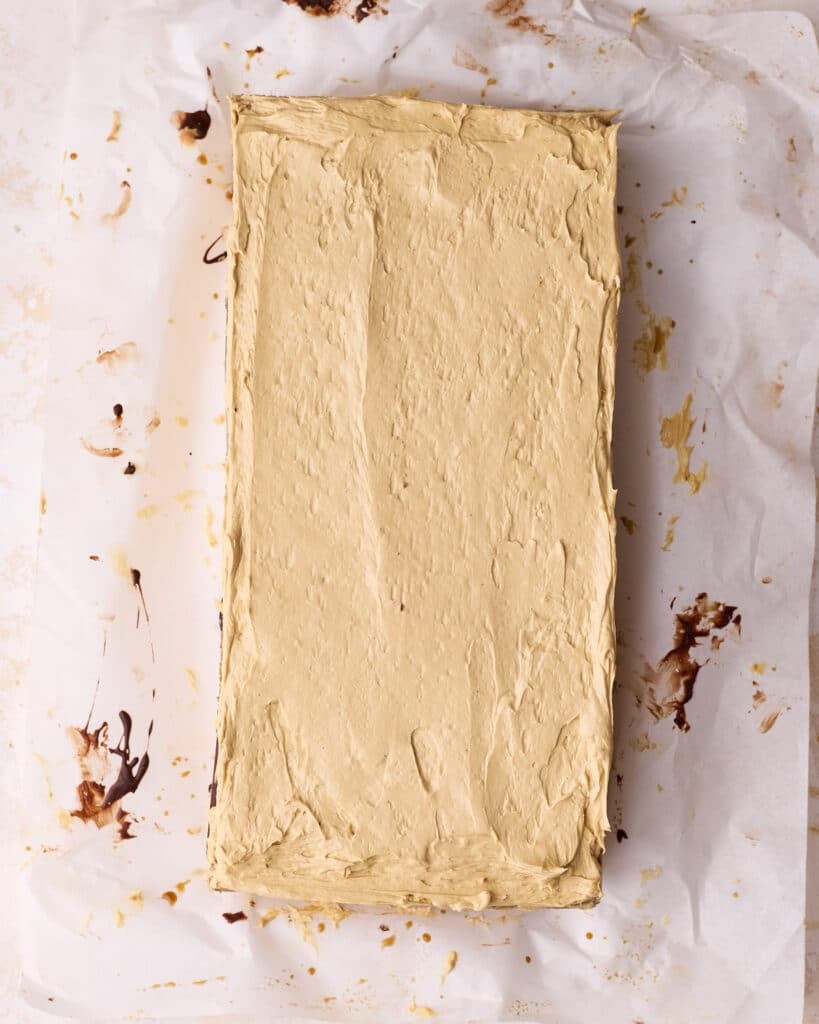
Top Layer
Spread the remaining coffee buttercream on top into a nice, smooth finish.
Chill the entire cake in the fridge for 30 minutes or until the buttercream doesn't stick to your finger when touched.
Make the Chocolate Glaze
The glaze is just the same as the chocolate ganache, but with a slightly different ratio, and added corn syrup for shine. It's best to make it right before pouring, as it needs to be a specific consistency to spread out smoothly.
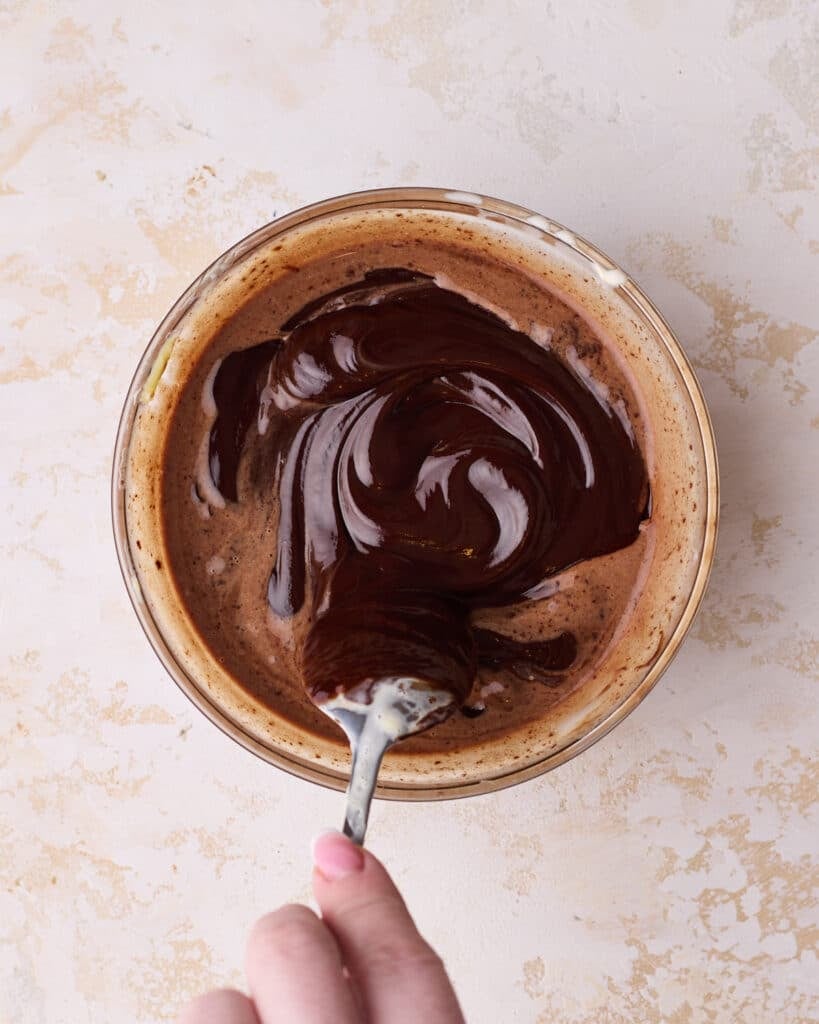
Make Glaze
Put the chopped chocolate, butter, and corn syrup together in a bowl, then heat the heavy cream in a saucepan until scalding, just like we did for the ganache earlier.
Pour the cream into the bowl and let sit for 1 minute, then stir together until smooth and glossy.
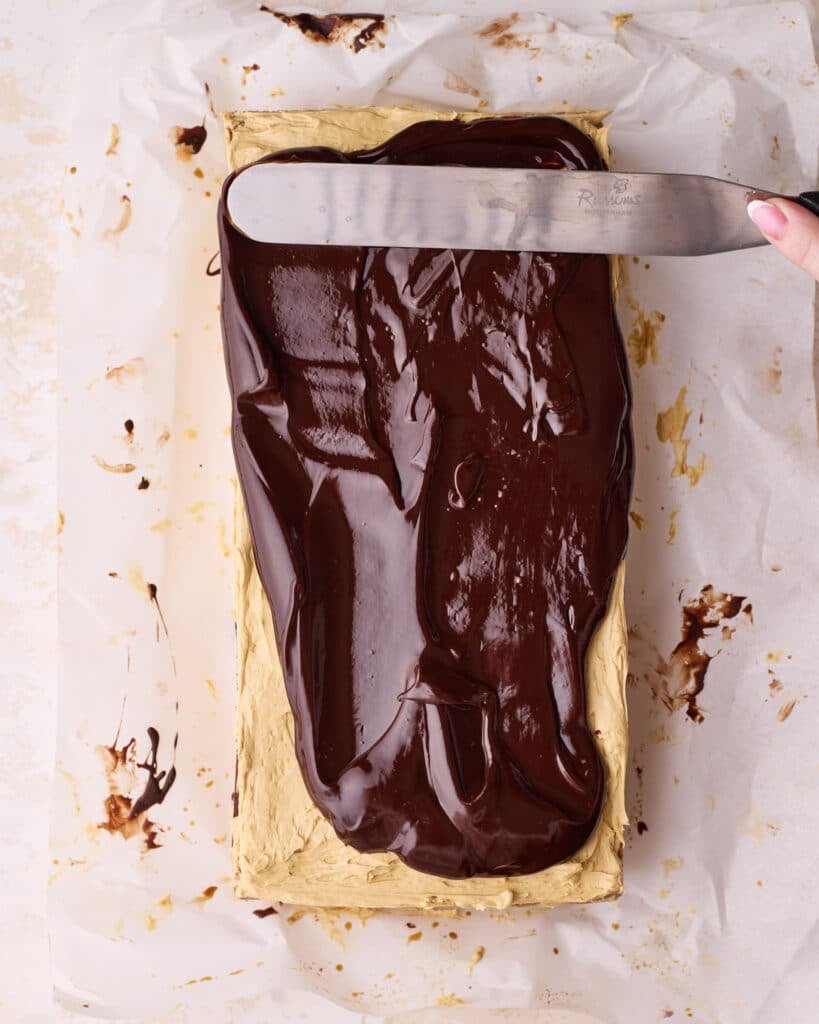
Glaze the Cake
Pour all of the glaze on top of the chilled cake and spread it out to all four corners. Then use your spatula to do one smooth swipe across the top.
Put it back in the fridge to set for 10 minutes.
Trim the Edges
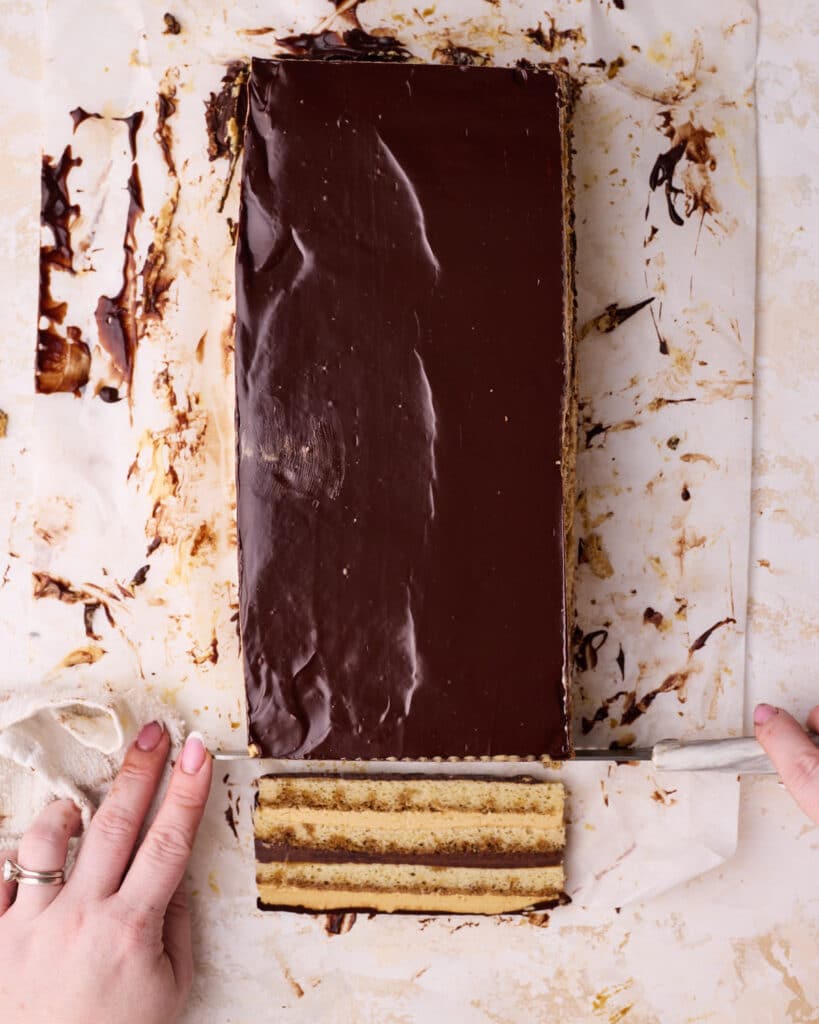
Lift the opera cake off of the serving plate using the parchment paper and set it down on your countertop.
Using a long, serrated knife, trim the edges of the cake to create clean, sharp sides.
See my tips below for slicing.
Slice
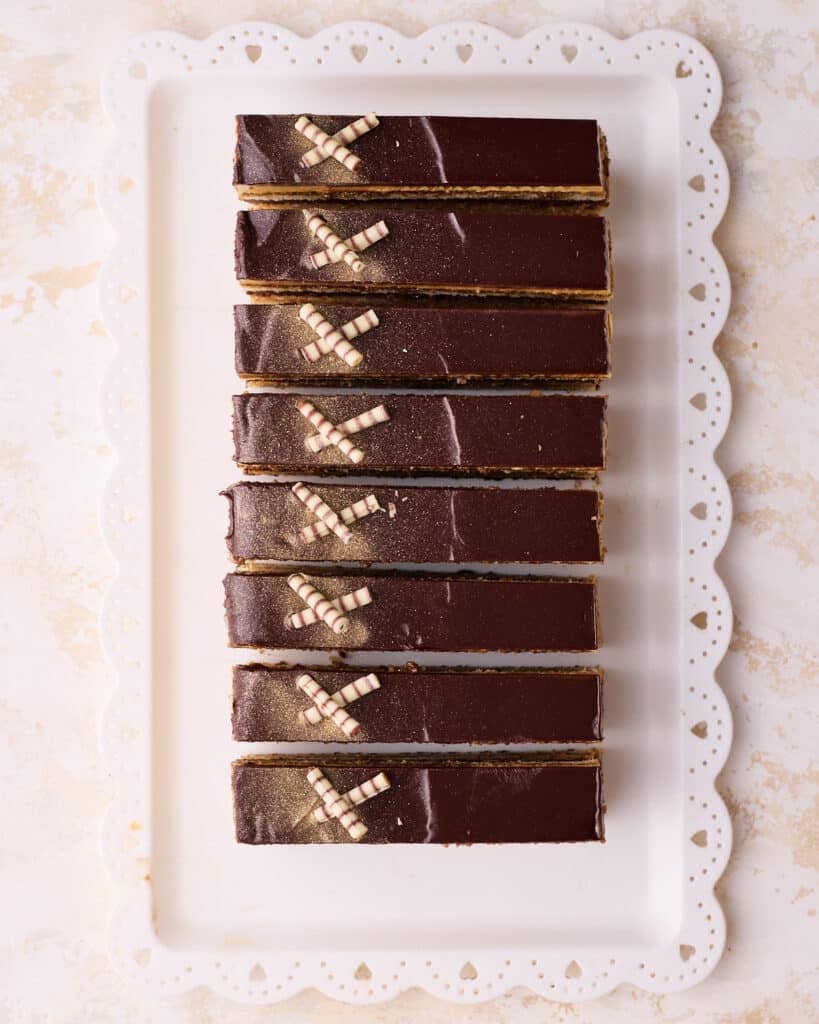
If serving the cake whole, carefully transfer it back to the serving plate.
For individual slices, use my slicing tips below to cut the slices to whatever size you like.
The chocolate layer on the bottom of the cake will help you to easily move the slices around on the serving plate without them getting stuck.
How To Get Perfect Slices
If you spend this long making all the beautiful layers of an Opera cake, you might as well take a little extra care to slice it and show off those layers. Here are my tips for how to slice an Opera cake:
- Use a long knife, preferably serrated, but a sharp one will work too.
- Warm the knife in hot water, then wipe it dry with a paper towel.
- Position the knife at the top edge of the cake, parallel to the countertop. Push straight down, keeping the blade level, until you cut through to the bottom.
- Once the knife reaches the bottom, slide it carefully along the base to ensure a clean cut.
- Re-warm and wipe the knife after each cut to keep the layers neat and intact.
- If serving the cake whole, carefully transfer it back to the serving plate.
- For individual servings, use the same technique to cut the cake into slices. Transfer the slices to the serving plate or serve them individually.
- The chocolate layer on the bottom of the cake will help you to easily move the slices around on the serving plate without them getting stuck.
Decorating Opera Cake
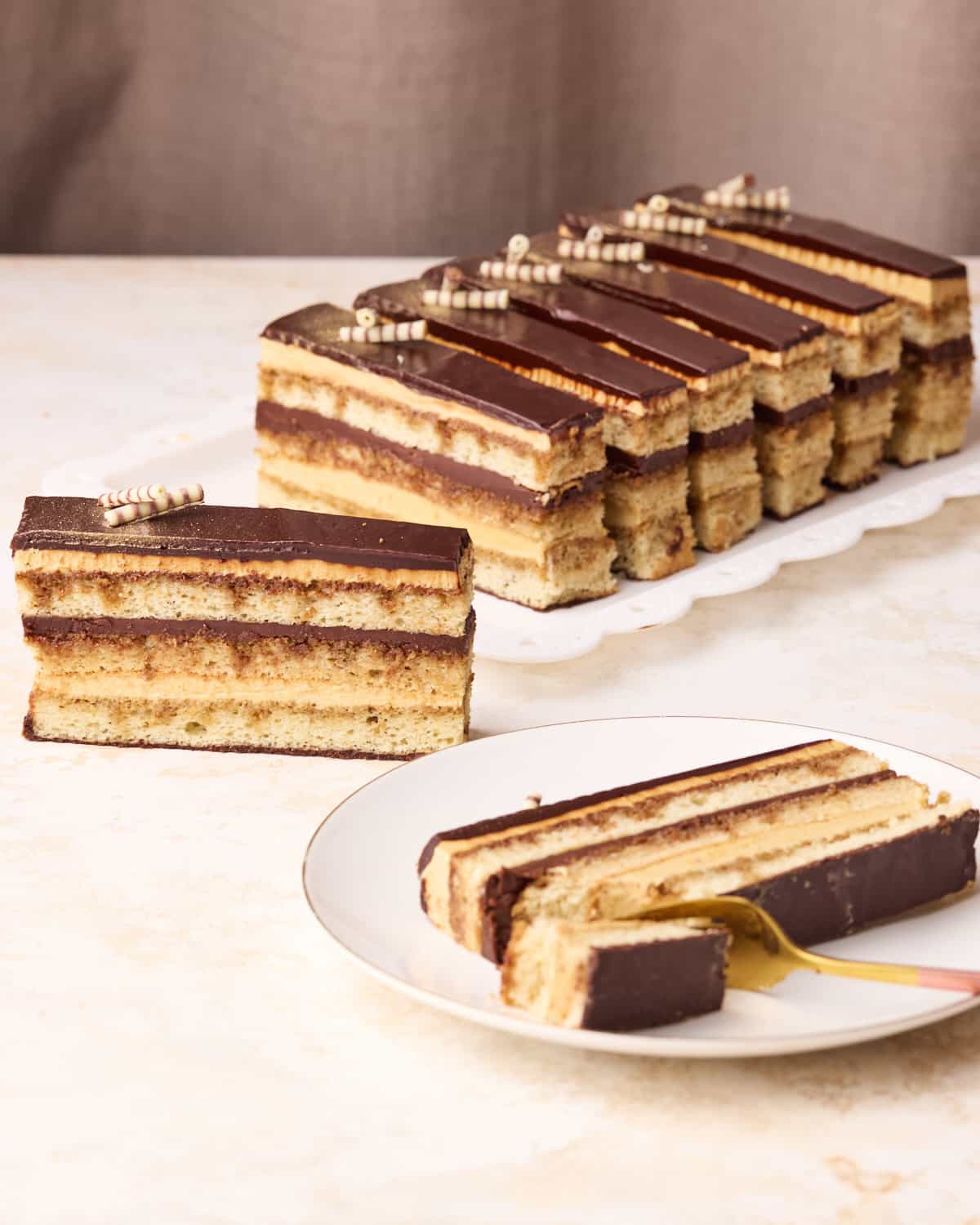
The traditional way to decorate Opera cake is to pipe the word 'Opera' with melted chocolate, either on the whole cake or on each individual slice.
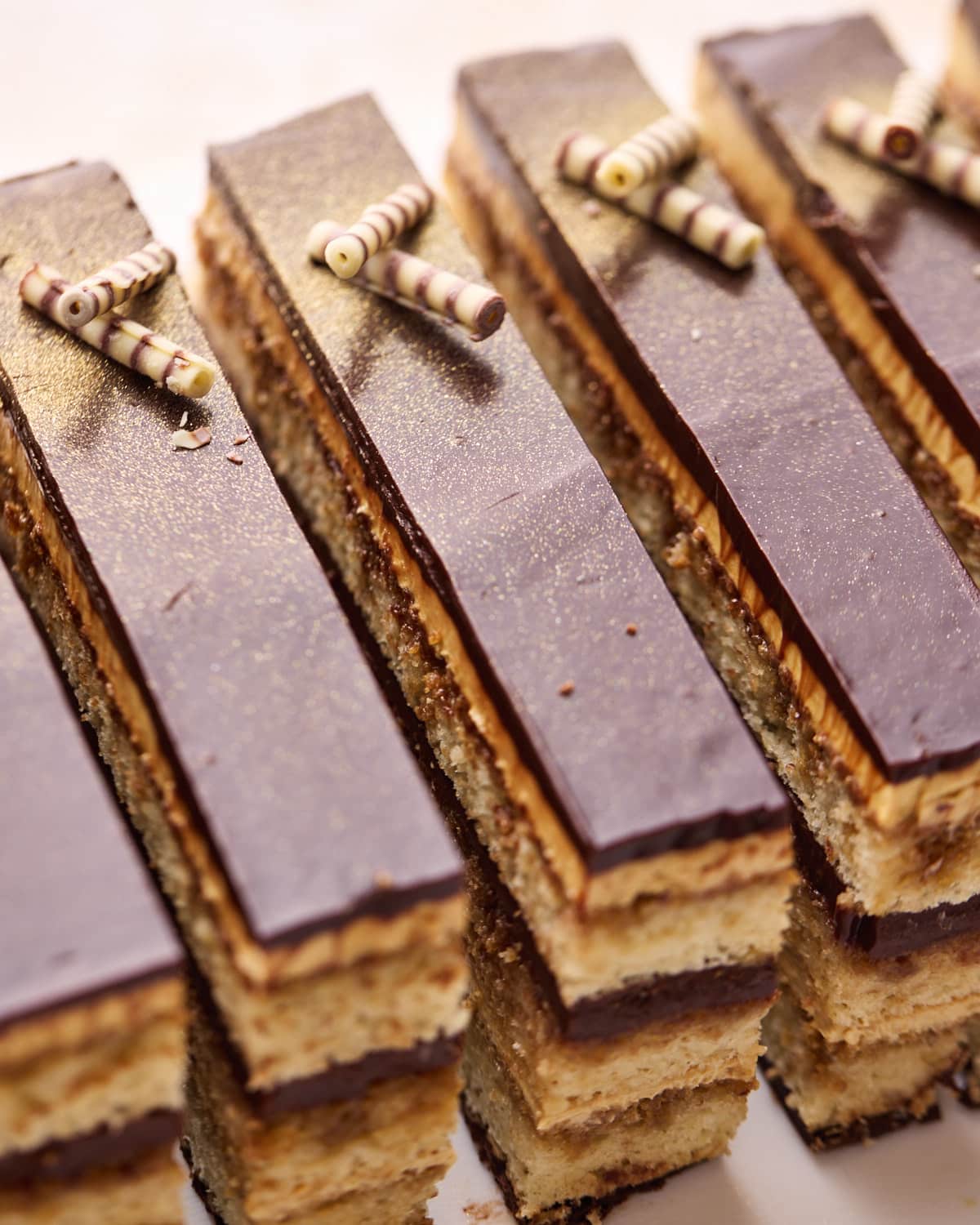
Although my recipe is authentic, I decided to spruce up the decoration a little with some chocolate rolls and a little edible glitter.
You can decorate however you like, or even leave it plain and let the focus be on those gorgeous layers!
Pastry Chef Tips
- When separating your eggs, make sure you don't get any yolk in the egg whites at all as this will prevent them from whipping up.
- When making the buttercream, it's important to use softened butter. I find the best results when taking it out of the fridge about 1 hour before using it. You should be able to easily make an indent with your finger, but it should still feel cool to the touch.
- The ganache needs to be cooled enough that it has a thick, spreadable consistency. Otherwise, it won't hold up, and your layers will be messy.
- Pay close attention to making sure each layer is even and flat. Crouch down so the cake is at eye level and check that it looks straight all the way across. This will ensure you have gorgeous, even cake layers when you slice the Opera cake.
- Some people find it easier to use a piping bag to apply the ganache and buttercream in an even layer.
Storage
Store your Opera cake in the refrigerator in an airtight container. Joconde sponge can dry out very quickly if it is exposed to air, so make sure it is airtight.
It can be stored in the fridge like this for up to 3 days.
While the cake needs to be chilled for storage, it is best served at room temperature, so take the cake, or individual slices, out of the fridge 30-60 minutes before serving.
Opera Cake FAQs
If you have a question about this recipe that isn't answered here, please write it in the comment section, and I will get back to you as soon as I can.
Though Tiramisu and Opera cake both contain sponge cake soaked in espresso, tiramisu is a lighter dessert layered with mascarpone cream, whereas Opera cake has rich, decadent layers of coffee buttercream and chocolate ganache.
Also, the sponge used in Tiramisu is a genoise sponge, whereas the sponge in Opera cake is a joconde sponge, containing almond flour.
Opera cake is supposedly named after the Paris opera house because its many layers represent the many levels of the opera house.
The chocolate layer on the bottom of the Opera cake is optional, but it creates a base to stop the cake from sticking to the serving plate, making it easy to move around, and it also adds a nice crunch to the texture of the dessert.
A classic French Opera cake has seven layers, consisting of joconde sponge, coffee buttercream, chocolate ganache and chocolate glaze.
More Fancy Dessert Recipes
Looking for more desserts to impress? Try some of these show-stopping dessert recipes:
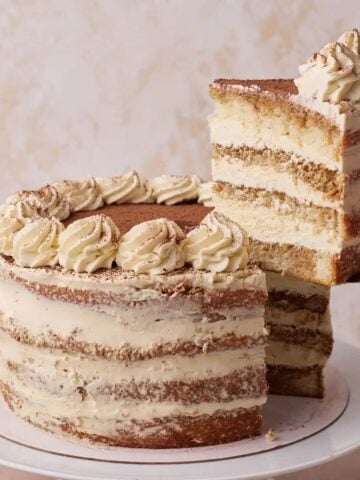
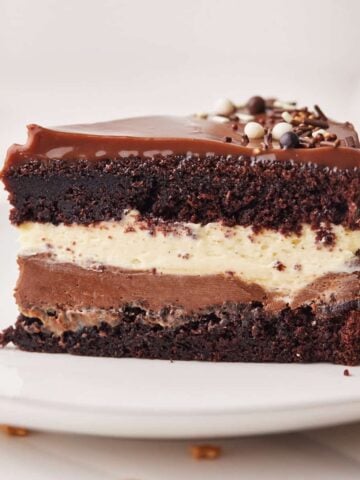
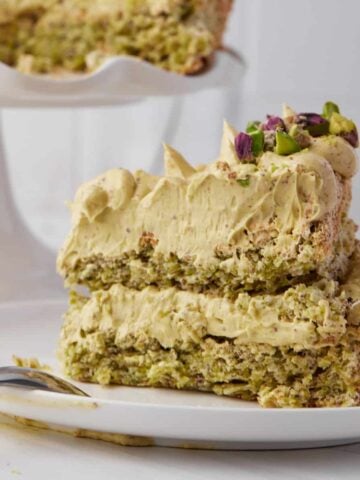
Opera Cake Recipe
Ingredients
- 160 ml (⅔ cup) Heavy Cream (double cream)
- 130 g (4.5 oz) Dark Chocolate chopped
- 1 tablespoon Unsalted Butter 15g (room temperature)
- 6 Large Egg Whites (keep yolks for the buttercream)
- 5 Large Eggs (room temperature)
- 200 g (1 cup) Granulated Sugar (caster sugar)
- 200 g (2¼ cups) Almond Flour (ground almonds)
- 40 g (⅓ cup) Cake Flour
- 2 tablespoon Unsalted Butter
- 100 g (½ cup) Granulated Sugar (caster sugar)
- 120 ml (½ cup) Water
- 2 tablespoon Espresso Powder
- 2 tablespoon Amaretto (optional)
- 6 Large Egg Yolks (room temperature - leftover from making the sponge)
- 150 g (¾ cup) Granulated Sugar (caster sugar)
- 60 ml (¼ cup) Water
- 227 g (2 sticks) Unsalted Butter (cubed)
- 1 teaspoon Vanilla Extract
- 1 ½ tablespoon (1½ tablespoon) Espresso Powder
- ¼ teaspoon Salt
- 85 g (3 oz) Dark Chocolate
- 2 teaspoon Vegetable Oil
- 160 ml (⅔ cup) Heavy Cream (double cream)
- 160 g (5.5 oz) Dark Chocolate (chopped)
- 1 tablespoon Unsalted Butter (room temperature)
- 1 tablespoon Corn Syrup (or liquid glucose)
Equipment
- Stand Mixer with whisk attachment
- Baking Sheet half sheet pan size
- Spatula
Instructions
- Make the ganache first so it has time to cool while you make the other elements. Put the chopped chocolate in a medium bowl and put the heavy cream in a small saucepan over medium heat.130 g (4.5 oz) Dark Chocolate
- Heat the cream, stirring occasionally, until it is scalding hot. This means that there is steam rising from it and you can see tiny bubbles appearing on the surface. Don't let it boil.160 ml (⅔ cup) Heavy Cream
- Pour the hot cream over the chocolate and let it sit for 1-2 minutes, then stir in circles in the middle of the bowl until it comes together into a glossy ganache and all the chocolate has melted.
- Stir in the room temperature butter until it has melted completely. Set the ganache aside to cool and thicken to a spreadable consistency.1 tbsp Unsalted Butter
- Preheat the oven to 400°F / 200°C (180° fan-assisted). Line a half-sheet pan with a silicone baking mat or parchment paper and spray with baking spray. Divide the sugar by putting roughly ⅓ of it into a separate bowl. Melt the butter in the microwave in a medium bowl and then set aside to cool while you make the batter.200 g (1 cup) Granulated Sugar, 2 tbsp Unsalted Butter
- Whip the egg whites on high speed in a stand mixer with the whisk attachment until they start to get frothy.6 Large Egg Whites
- Take the smaller bowl of sugar and add it to the egg whites as they whip, one tablespoon at a time. Wait for about 15 seconds in between additions to give the sugar a chance to dissolve into the egg whites.
- Once all the sugar has been added, keep whipping until a stiff meringue forms. It should be just before the stiff peaks stage, which means it will form firm peaks, but the top will still droop over slightly into a hook shape. Be careful not to overwhip the meringue.
- Transfer the meringue to a separate bowl, then use the empty stand mixer bowl to combine the 5 whole eggs, almond flour, and remaining sugar. There is no need to clean your bowl in between.*200 g (2¼ cups) Almond Flour, 5 Large Eggs
- Whip together on high speed until it reaches the ribbon stage. This means that the mixture falls from your whisk in a steady stream and leaves a pattern on top of the batter for a few seconds before disappearing.
- Scoop half of the meringue into the batter and fold it in gently with a rubber spatula until it is almost incorporated, but some pieces of white are still visible. Then add the remaining meringue and repeat, also only until almost incorporated.
- Sift the flour on top of the batter and fold it in until completely incorporated. Make sure you get any flour from the bottom of the bowl.40 g (⅓ cup) Cake Flour
- Use your spatula to scoop a dollop of batter into the bowl of melted, cooled butter and mix it in thoroughly. This is called 'sacrificing' the batter, and it will help the butter to mix into the rest of the batter.
- Add the sacrificed batter back into the main batter and gently fold it in with the spatula.
- Pour the joconde batter into the prepared pan and gently spread it out to all the corners. Use your spatula or palette knife to get the batter as level and even as possible as it won't level out by itself in the oven.
- Bake the sponge for 12-16 minutes or until it is starting to get a little color, is pulling away from the edges of the pan, and it springs back slightly when you press on it. Leave to cool completely before removing from the pan.
- Once cooled, run a knife around the edges of the pan, then lay a large sheet of parchment paper on top of the sponge. Flip the pan upside down on the counter so that the sponge is sitting on top of the parchment paper. Peel away the mat or parchment paper that it was baked on.
- Take 1 tablespoon of the water and mix it in a small bowl with the espresso powder until it dissolves. Set aside.2 tbsp Espresso Powder
- Put the rest of the water in a small saucepan with the sugar over medium-high heat and bring to a boil until the sugar has dissolved and the liquid turns clear.120 ml (½ cup) Water, 100 g (½ cup) Granulated Sugar
- Remove from the heat and add in the dissolved espresso and the amaretto (if you want to add it). For a non-alcoholic version, just replace the alcohol with an equal amount of water.2 tbsp Amaretto
- Leave the coffee soak to cool while you make the buttercream.
- Put the egg yolks into a clean stand mixer bowl and whip on medium-high speed until they are thick and very pale in color (about 5 minutes).6 Large Egg Yolks
- In a small saucepan with a candy thermometer, make a sugar syrup by boiling the sugar and water over medium heat until it reaches exactly 240°F / 115°C.150 g (¾ cup) Granulated Sugar, 60 ml (¼ cup) Water
- Immediately remove from the heat and, with the stand mixer on low speed, pour the hot syrup into the egg yolks in a very slow and steady stream. Try not to let the syrup hit the moving whisk as you pour.
- Turn the mixer up to high speed and whip until the mixture no longer feels warm, this may take about 10 minutes.
- Once the mixture has cooled enough that it doesn't feel warm to the touch, you can start adding your butter. With the mixer on high speed, add one chunk of butter at a time, letting each chunk incorporate before adding the next.227 g (2 sticks) Unsalted Butter
- Once all the butter is added, continue to whip on high speed for 1 minute. You should have a thick, glossy buttercream.
- Dissolve the espresso powder in a splash of hot water, then add it to the buttercream along with the vanilla and salt. Whip for 30 seconds everything is combined.For detailed tips, process pictures, and troubleshooting, see my French Buttercream post.1 tsp Vanilla Extract, 1 ½ tbsp (1½ tablespoon) Espresso Powder, ¼ tsp Salt
- Make sure you have all the elements ready and laid out in front of you. It's also best to have some kind of flat serving plate to work on so you can easily put the opera cake in and out of the fridge.
- Heat the dark chocolate in the microwave in 30-second increments until it is completely melted. Stir in the vegetable oil.85 g (3 oz) Dark Chocolate, 2 tsp Vegetable Oil
- Position the joconde sponge in front of you, and using a sharp knife, cut it into three even rectangles (see the process pictures in the post above for guidance). For the most accurate results, I like to use a measuring tape to measure the whole length and divide by 3, to make sure I get three equal sizes.
- Set two of the rectangles aside on the parchment paper. Place the remaining rectangle on a separate piece of parchment paper, on the serving plate. Spread the melted chocolate on top of the joconde and smooth it out as evenly as possible. Don't worry about getting the edges perfect, as we are going to trim them later anyway. Put it in the fridge to set for 5-10 minutes, until it is completely hard.
- Once the chocolate is hard, flip the joconde sponge over so the chocolate side is on the bottom. Then use a skewer to poke holes all over the top - this will help the coffee syrup to soak into it, making it moist and filling it with flavor.
- Brush the coffee syrup all over the sponge with a pastry brush, then repeat once it has soaked in a little. Be generous with it, but don't oversaturate or it will go soggy.
- Put roughly half of the french buttercream on top of the sponge and spread it out as smoothly and evenly as possible. Crouch down to look at the cake at eye level to check for evenness - if the layers are not even, then the finished cake won't be either. Again, don't stress too much about the edges as they will be trimmed later.
- Put the next layer of joconde sponge on top and repeat the process with poking holes and soaking with syrup.
- Spread all of the ganache on top of this cake layer and smooth it out.
- Top with the final cake layer, poke holes and soak with coffee syrup.
- Spread the remaining French buttercream on top into a nice, smooth finish. Put the opera cake in the fridge to set for 30 minutes.
- After 30 minutes, check the cake by lightly touching the top of the buttercream, it should be set to the touch and not stick to your finger at all.
- Put the chopped chocolate, butter and corn syrup together in a bowl, then heat the heavy cream in a saucepan until scalding, just like we did for the ganache earlier.160 g (5.5 oz) Dark Chocolate, 1 tbsp Unsalted Butter, 1 tbsp Corn Syrup, 160 ml (⅔ cup) Heavy Cream
- Pour the cream over the chocolate, butter, and corn syrup, let sit for 1 minute, then stir together until smooth and glossy.
- Take the opera cake out of the fridge and pour all of the glaze on top, spread it out to all four corners, then use your spatula to do one smooth swipe across the top. Put the opera cake back in the fridge to set for 10 minutes.
- Lift the opera cake off of the serving plate using the parchment paper and set it down on your countertop.
- Using a long, serrated knife, trim off the edges of the opera cake to leave nice, clean edges. The best way to do this is to warm your knife in hot water, wipe dry with a paper towel, then position it at the top of the cake, parallel with the work surface, and push straight down, keeping it level until it reaches the very bottom.Once you have cut through the bottom, slide the knife along the bottom to make sure it has cut cleanly. Wipe and re-warm your knife in between every slice to make sure you don't mess up those beautiful layers.
- If you want to serve the opera cake whole, you can lift it and transfer it back onto the serving plate.To slice it, repeat the same process as for trimming the edges, cutting into individual slices. You can then transfer those slices back onto the serving plate or serve them up individually.


Lori G says
This was my first Opera cake. I have made other ambitious cakes (dacquoise/ marjolane), so I wasn't intimidated. However, I really took the time to read everything thoroughly before starting. It's so important. It gives you a sense of why you are completing a step because it will make sense later. My advice is to use the finer milled almond flour. WinCo had two - the courser/ browner type and the finer, lighter, more powdery type. And use exceptional unsalted butter for your French buttercream. Ditto, chocolate and espresso brands. I used Callebaut dark, but will probably choose Lindt 70% next time.
It came out beautifully with some select trimmings. Great recipe and step layout. I wish I could post a picture!
Thomas says
I tried this recipe yesterday and I must say that it is absolutely delicious!
I really like how you have laid out the steps in the recipe and include a reference to the relevant ingredients and corresponding measures for each step. Clear and easy to follow!
I have two questions:
Are there any elements of this recipe that can be prepared a day ahead of assembly? Can I, for example, create the sponge the day before?
The second question: The almond flour I used was fairly coarsely ground. I felt that it gave a quite nice texture, but I am unsure if this is how the recipe is intended to be made.
GARY L GIBBONS says
This recipe is marvelous and pretty close to competition level; however, this website that presents your recipe is the worst. The ad campaigns completely overwrite and block recipe views, breaking up any continuity in the steps that are necessary. The ads are so invasive it forces the browser to reset back to the page top (beginning), and if the browser resists, the page complete hangs. If the ads continue, the browser logs out and resets to home page.
This is in Chrome, and the only website causing such intolerable behavior is bonnibakery.com.
Yes, I printed the recipe and followed that - it was the only way to complete the project uninterrupted. I know it's all about the revenue, but I'd wager that the revenue is either very weak or declining, or maybe even nonexistent.
If you fix your website to be user friendly, you're more likely to garner way more ad revenue.
Jules Grasekamp says
Hi Gary,
Thank you for your thoughts.
I have never heard of this issue happening on Chrome before, I'd love to get some more details so I can bring it up with my ad network. There is a known issue with apple devices causing web pages to refresh and go back to the top of the page, but I have not heard of it happening outside of that. I'd really appreciate if you could send any details of this to jules@bonnibakery.com so I can get it looked into immediately.
I'm so glad that you enjoyed the recipe itself, it's unfortunate that you have given the recipe itself only 3 stars even though you enjoyed it so much, as all this affects is the actual recipe rating, nothing to do with the website.
I'm glad you appreciate that ad revenue is how recipe developers like myself are able to provide these recipes free of charge to users, that is often difficult to explain to people. I can assure you that bonni bakery is doing very well and on the contrary has actually been growing rapidly year on year. We very rarely get complaints about the ads, but user experience is very important to me so if they are causing issues like you described I am keen to rectify it quickly.
Thank you again for your kind words about the recipe, and I appreciate you bringing the site issues to my attention.
Thank you,
Jules
In a galaxy far away says
So "half sheet pan" means 13" x 18" to me (half of a commercial sheet pan). Is that consistent with what you meant by half-sheet pan? (Just making sure, because I think so many home bakers have 13x9).
Jules Grasekamp says
Hi there,
Great question! Yes a half sheet pan is 13" x 18". A 13" x 9" pan is considered a quarter sheet pan.
If you have quarter sheet pan you can definitely still make this recipe, you'll just bake in multiple batches and piece the cake together into the size and shape you need once cooled.
Hope this helps and hope you love the Opera cake!
Happy baking 🙂
Jules
In a galaxy far away says
Thank you very much for your reply and confirmation. I've had interest in adding classic Opera cake for a little while and appreciate that you have it scaled to half-pans.
Anon says
Thanks for the response.
Could you advise what syrup will go with the pistachio version
Look forward to your other delicious recipes.
Jules Grasekamp says
You could do an almond syrup - that would work nicely. So you could either make this with the amaretto and just leave out the coffee, or if you don't want alcohol in it you could make a basic sugar syrup and add some almond extract.
Almond compliments pistachio flavor really well!
Jules
Anon says
Many thanks the cake came out out delicious.
Jules Grasekamp says
So glad to hear that! Thank you for trying my recipe and for taking the time to let me know how it turned out 🙂
Jules
Chris says
I can't describe how tasty this is! The closest thing I can come up with is, it tastes like rich people dessert. SO GOOD! Plus they look like neat little soldiers when cut and lined up.
Sarah Scalier says
Looks incredible! Can't wait to try it. Thanks for such an amazing, easy-to-follow recipe, Jules!
Anon says
Hi, i was looking for a opera recipe and came across yours. Can I attempt half the recipe? And can I make it a pistachio almond with a mlikybar chocolate ganache flavor.
Your tips recipe and tips are very informative thanks
Jules Grasekamp says
Hi there,
You can definitely half the recipe - the beauty of Opera cake is you can make it any size or shape you like really.
A pistachio version with pistachio ganache sounds absolutely divine! However, I would avoid using milkybar to make your ganache as milkybar is not proper white chocolate, it is a candy bar, so it won't melt the same way as white chocolate does.
I hope your cake turns out beautifully - maybe I will develop a pistachio version too!
Jules