
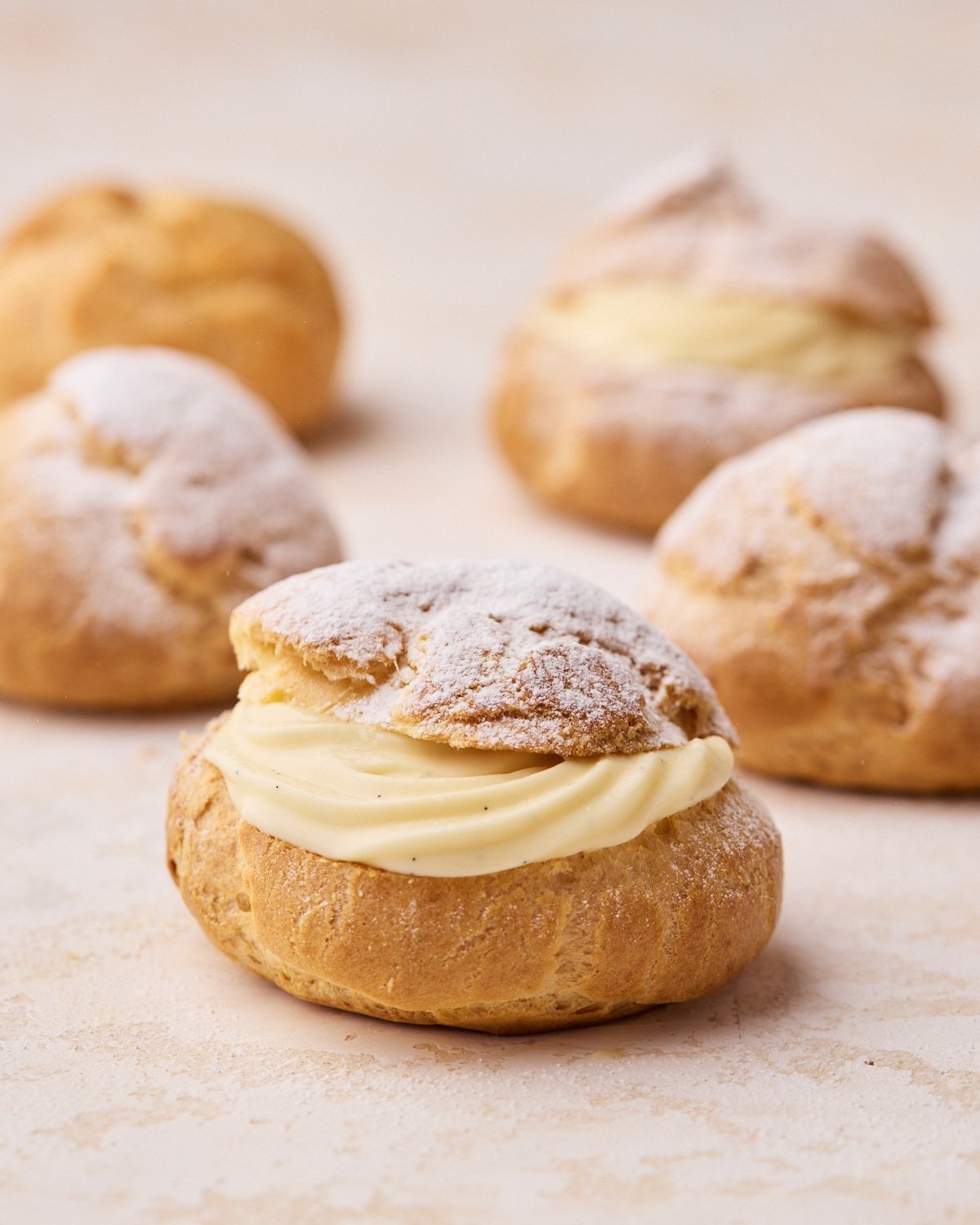
How to make foolproof choux pastry that bakes up crisp, golden, and hollow - with clear visual cues so you know exactly what the dough should look like at each stage.
Choux Pastry Recipe Snapshot
What it is: French pastry that puffs up in the oven and bakes light and crisp for desserts like eclairs and cream puffs.
Why you'll love it: It's a simple recipe that opens up a world of dessert possibilities once you've mastered the technique.
How to make it: Boil milk and water with melted butter, then beat in flour and gradually add eggs. Pipe and bake.
I was convinced for a while that I was just cursed when it came to choux pastry - every batch had a new issue. Flat buns, soggy shells, ones that puffed up beautifully and then collapsed the second they came out of the oven…
Turns out, it wasn't bad luck or pastry voodoo - I just didn't have the right information.
Once I finally figured out what the dough should actually look like at each stage, things clicked. This recipe walks you through everything I learned so you can make crisp, golden shells that puff up properly and stay hollow inside.
Jump to:
What Is Choux Pastry?
Choux pastry (or pâte à choux) is a classic French pastry dough that's used to make light desserts such as profiteroles, cream puffs, and eclairs.
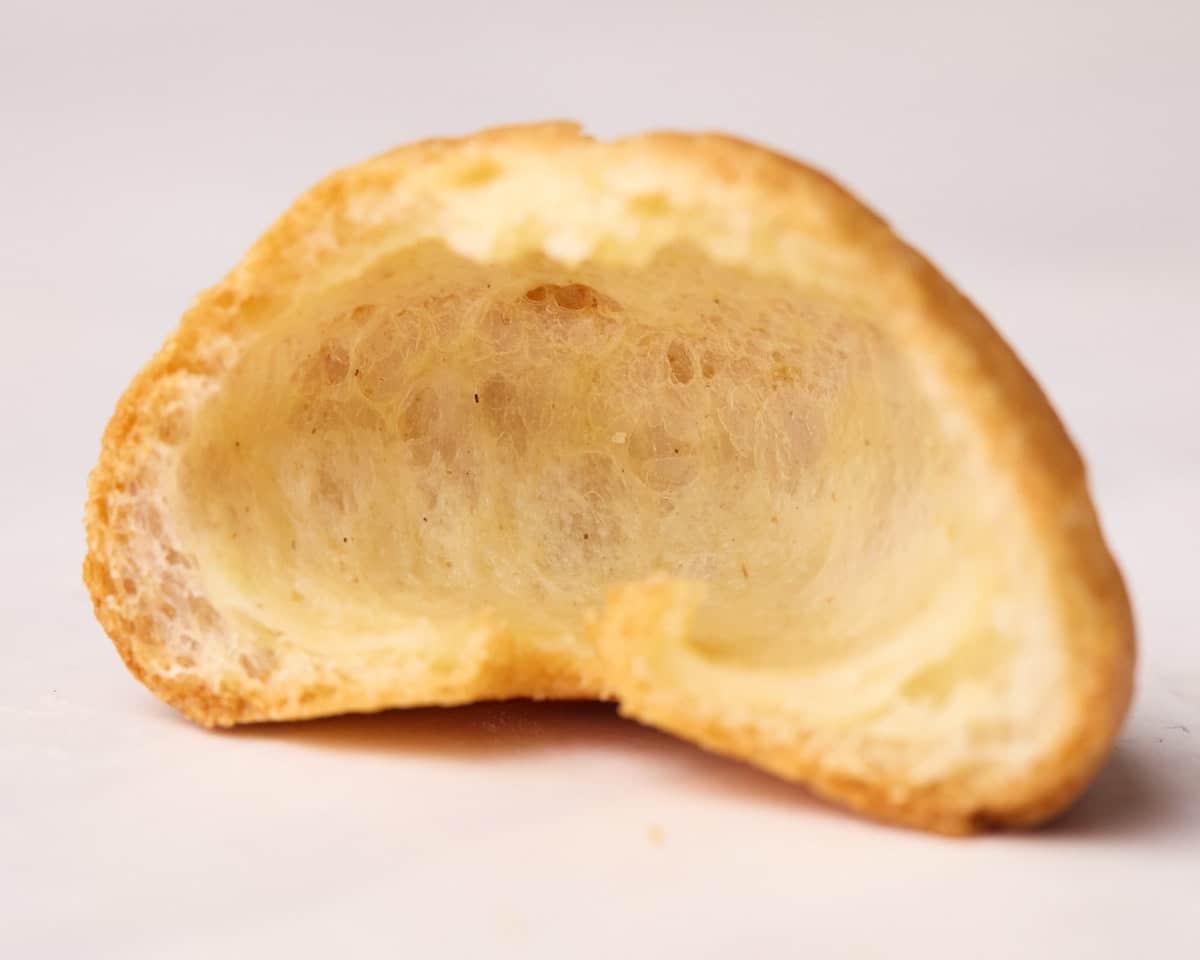
When it's baked properly, steam rises inside the pastry to puff it up and make crisp shells with a hollow centre - to be stuffed with all kinds of delicious fillings like pastry cream.
Ingredients
Choux pastry only uses a few basic ingredients, but each one plays an important role. Small changes here can have a big impact on how the pastry bakes.
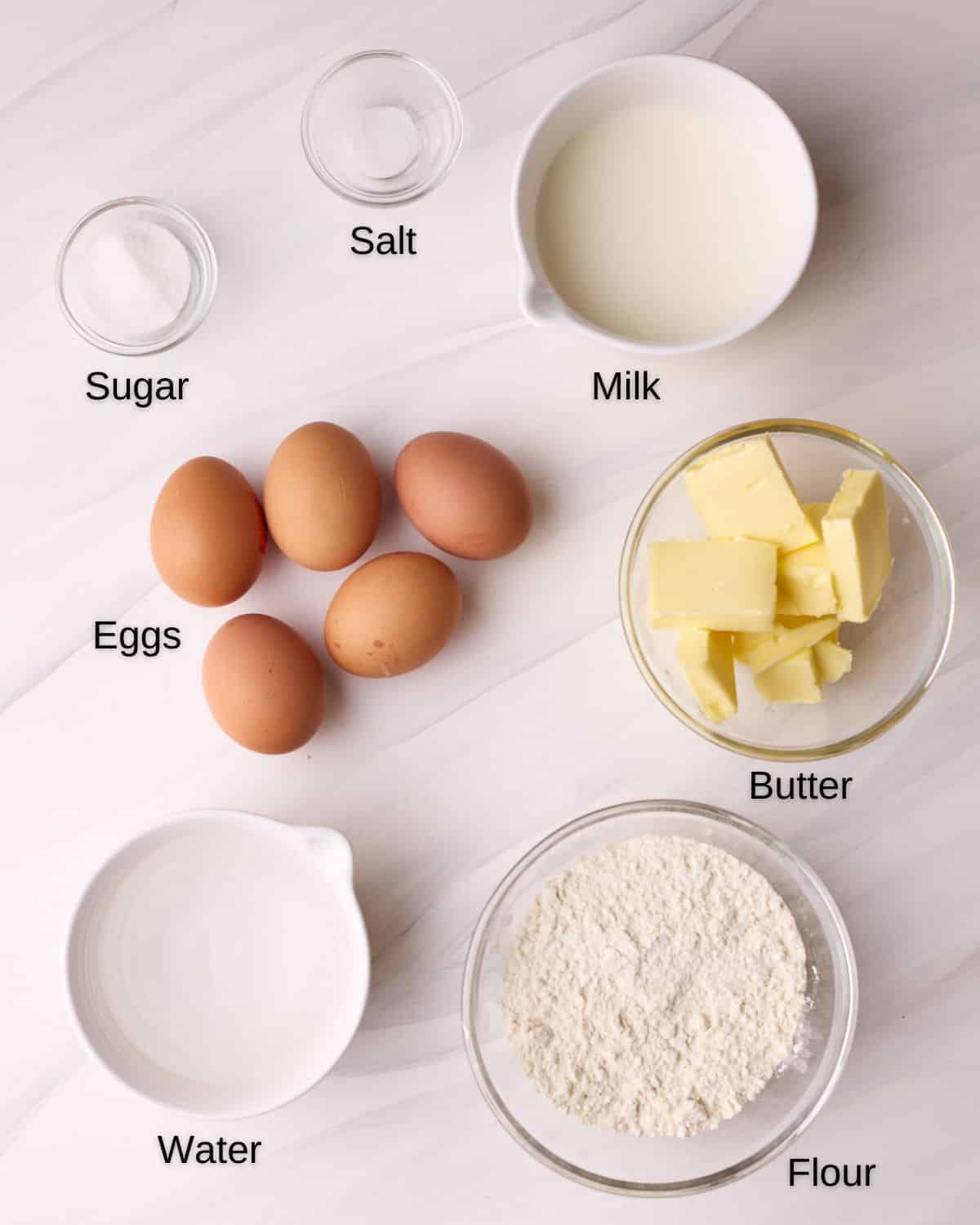
- Water / Milk - The liquid in choux pastry is what creates the steam that makes it puff. You can use all water, all milk, or a combination of the two. After a lot of testing, I like to use a mixture of half milk, half water for a good rise from the water, with a bit more flavour and colour from the milk.
- Butter - Use unsalted butter.
- Salt - You won't taste the salt, but it's essential. It strengthens the dough, helps bind the flour and liquid, and improves the overall structure of the pastry.
- Sugar - Choux pastry isn't meant to be sweet, but a small amount of sugar helps with browning. You can leave it out for savoury choux, but I usually keep it in anyway for better colour.
- Flour - All-purpose flour works best - it provides enough structure for the pastry to puff while still allowing it to expand properly in the oven.
- Eggs - Use large eggs at room temperature. The eggs help the walls of the pastry set while baking, so your choux doesn't collapse. The exact amount you'll need varies, so it's important to add them gradually and judge the dough by its texture rather than sticking rigidly to a number.
See the recipe card for measurements and the full recipe.
Things You'll Need
- Saucepan
- Wooden spoon
- Stand mixer - with paddle attachment
- Piping bag
- Baking sheet
How To Make Choux Pastry
Choux pastry is a little bit magic - just butter, flour, eggs, and liquid, and somehow it turns into these hollow, crisp little clouds. It's actually a fairly simple recipe, but good results come from the technique and how these simple ingredients are combined.
If you carefully follow these step-by-step instructions, you will end up with crisp pastry that puffs up beautifully.
Make The Dough
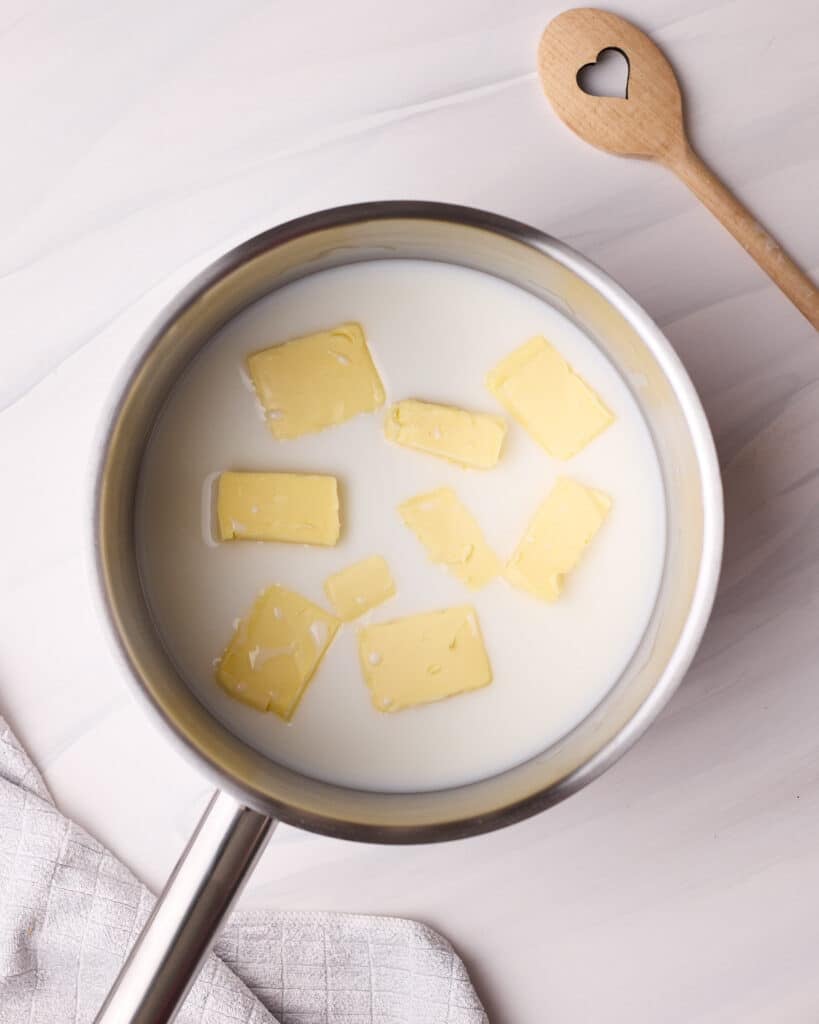
Boil Liquids
Combine the butter, milk, water, salt, and sugar in a medium saucepan and heat over medium heat, stirring occasionally until the butter melts and the liquid starts to boil. Remove from the heat.
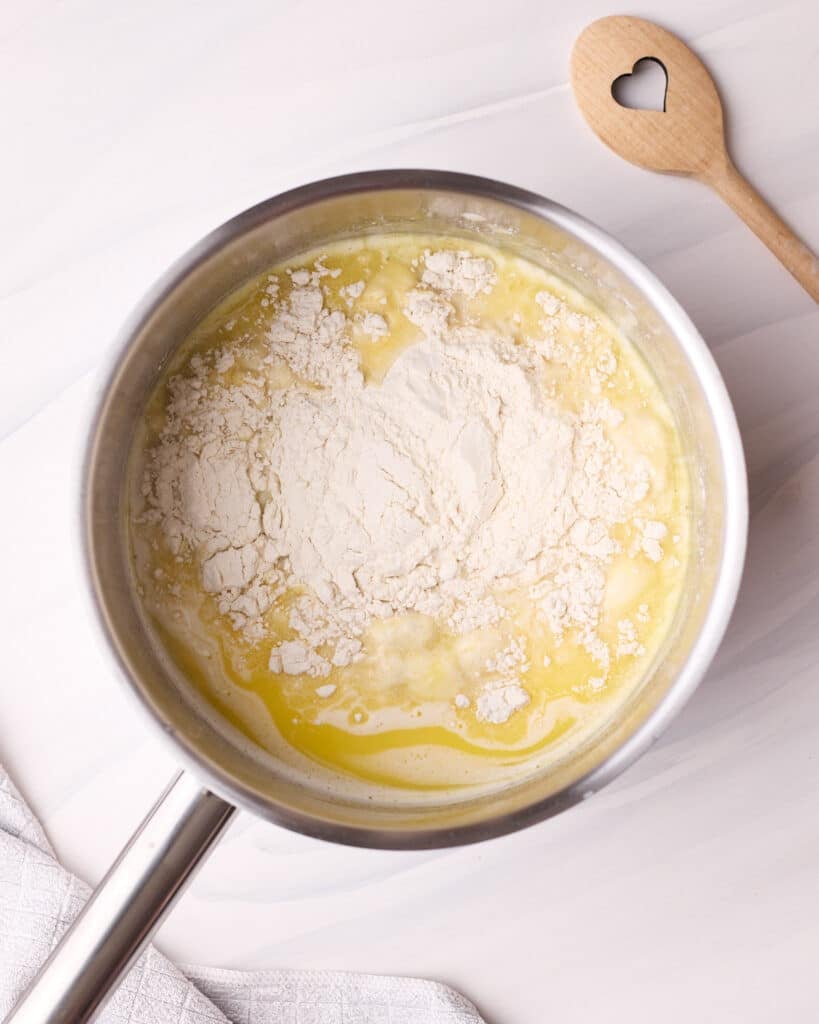
Add Flour
Add the sifted flour all at once and mix quickly with a wooden spoon or spatula until the flour is fully incorporated.
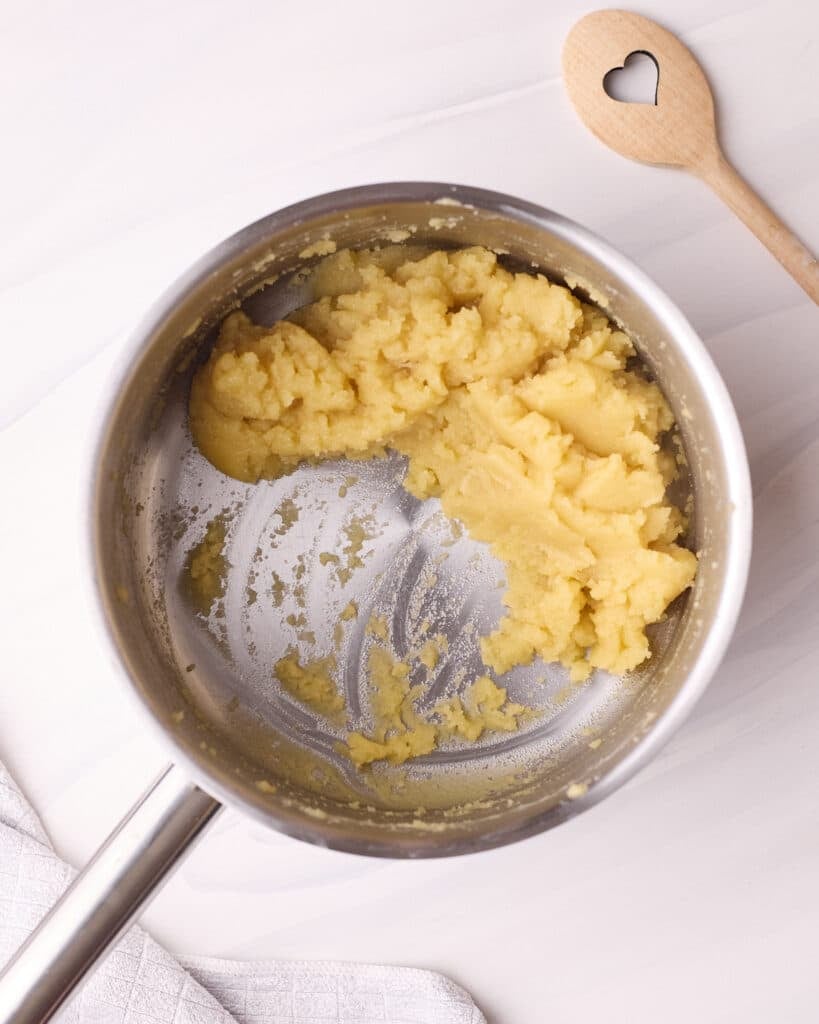
Cook the Panade
Return the pan to the stove and stir vigorously - you can kind of slap the dough against the sides of the pan until it forms a smooth dough and leaves a thin film on the bottom of the pan. If you swirl the pan around, it should form together into a ball.
This step dries the dough slightly and allows the starch in the flour to gelatinize, which is key to getting it pipeable and ensuring it puffs up in the oven.

Cool the Dough
Transfer the choux paste to the bowl of a stand mixer and use your spoon to spread it up the sides of the bowl to help it cool faster.
Leave to cool for at least 10 minutes until it is no longer hot to touch.
Add Eggs
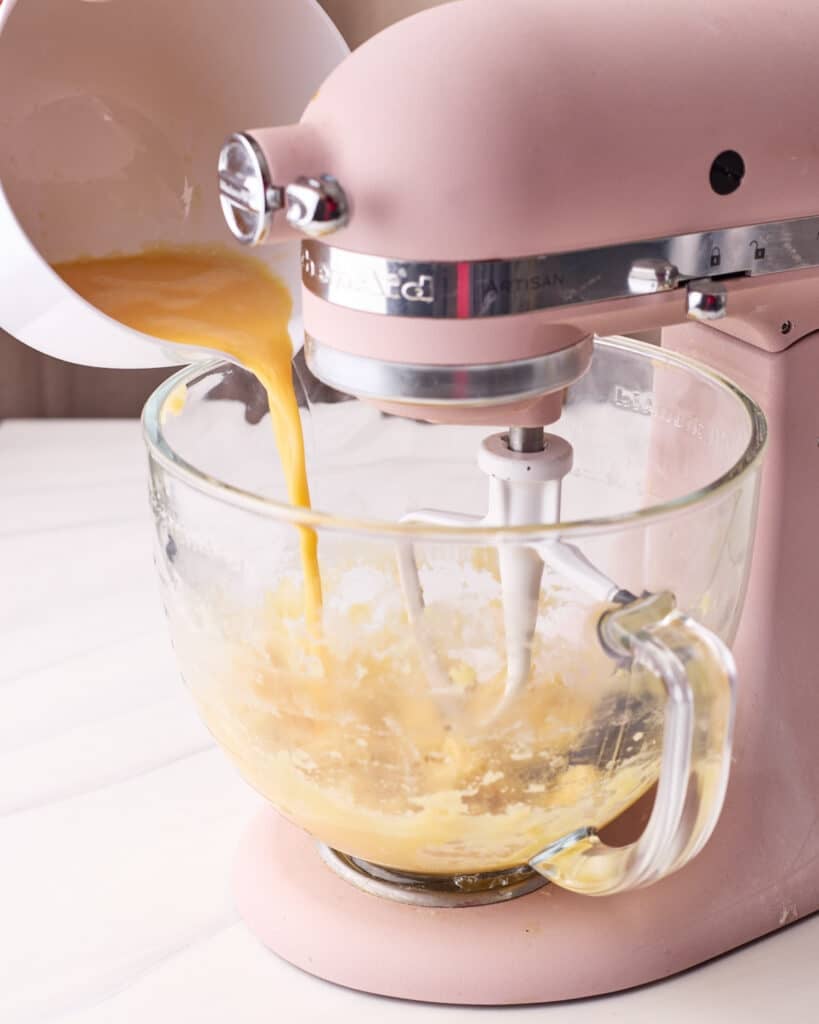
With the mixer on low speed with a paddle attachment, add the eggs one at a time, mixing thoroughly between each addition.
You might not need all of the egg, so for the final one, add it gradually and stop when the dough reaches the right consistency.
How To Know Choux Pastry Is Ready
Knowing when your choux is the right consistency is super important. You should look for it to be smooth, glossy, and pipeable. Here are a few ways to test if it's definitely ready:

- V-test - The best way to test is by dipping the mixer paddle, or a spatula, into the pastry and slowly lifting it out - the dough should fall off in a V-shaped trail.
- Trench test - It should be thick enough that you can draw a trench in it with your finger and it won't fill in.
- Pinch test - If you put a little pastry between your fingers and pull them apart slowly, the top should make a V shape, and the bottom should fall over on itself slightly.
Piping Choux Pastry
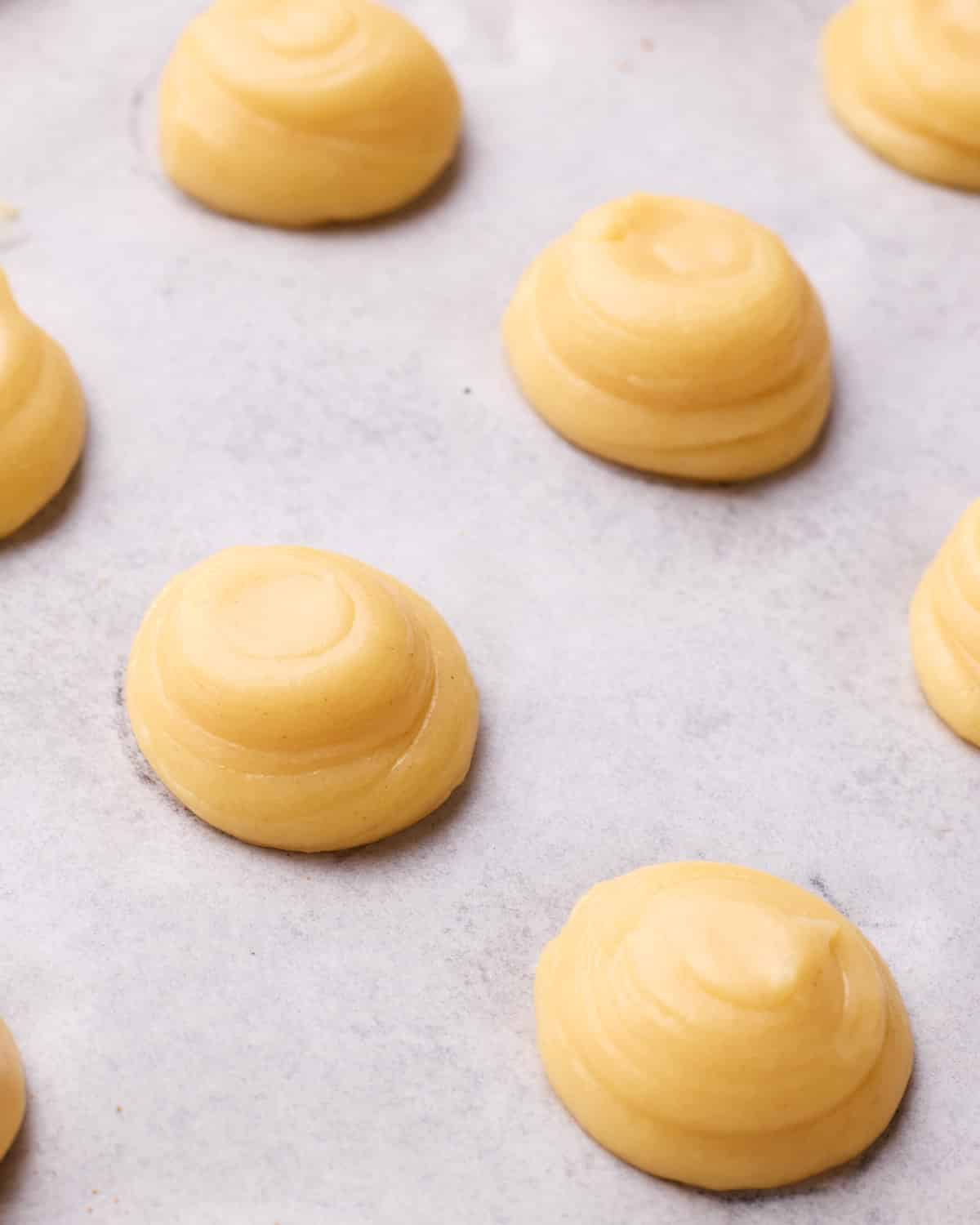
For choux buns - Use a round tip or just cut the end off of a piping bag. Hold the bag at a 90° angle to the pan. Keep the tip of the nozzle still to make little mounds of pastry.
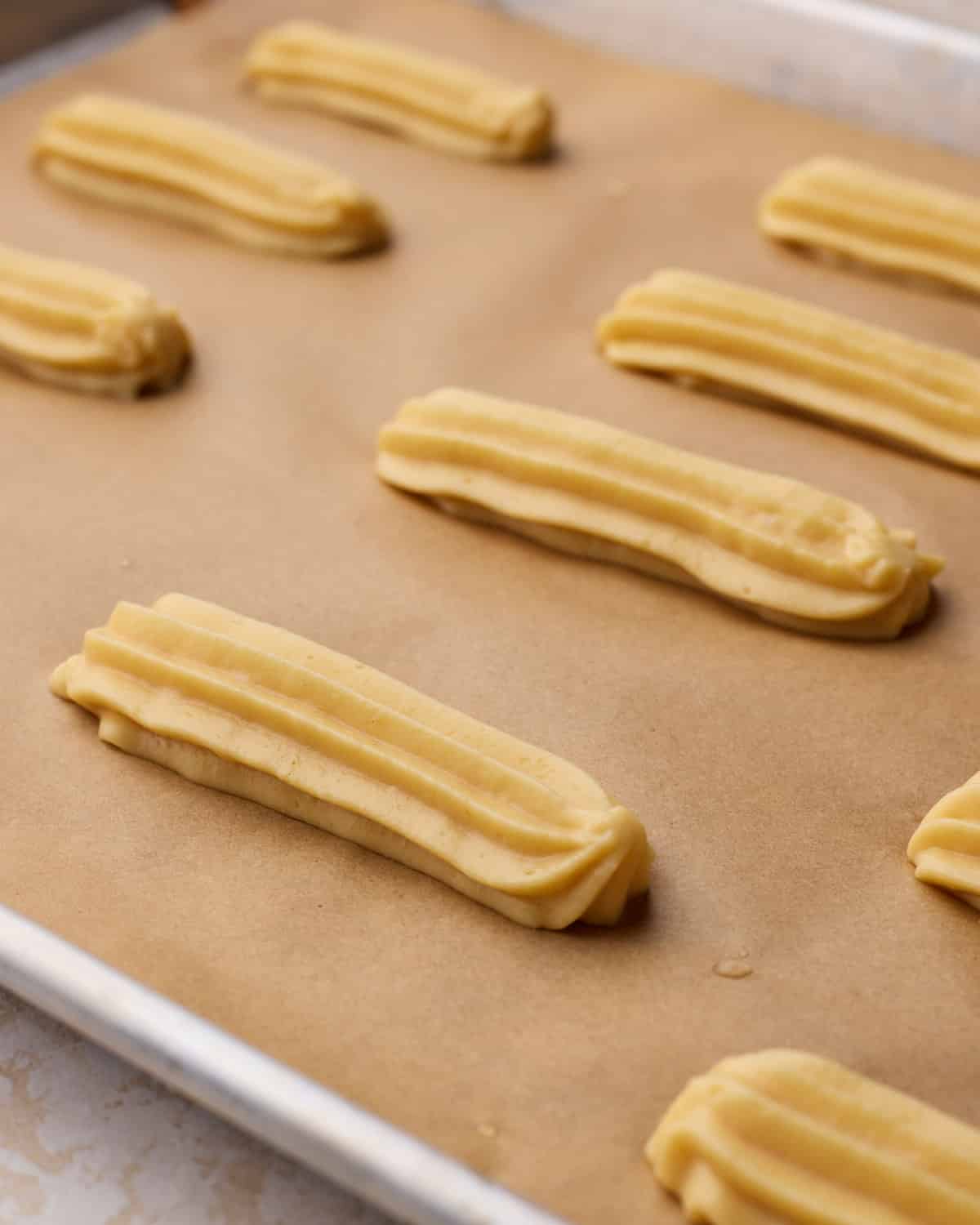
For eclairs - Use a star tip with lots of teeth (like a French star tip), hold the bag at a 45° angle, and squeeze evenly from start to finish. You can pat down the end of the eclairs with a wet palette knife.
- Put the choux pastry in a piping bag with a piping tip fitted; the kind of tip will depend on the final shape of your pastries.
- Squeeze any air bubbles out of the bag, then put a blob of batter underneath each corner of the parchment paper (this stops it from sliding around while you pipe).
- Apply steady pressure while you pipe and try to be as consistent as possible with sizing. It can be helpful to draw or print out a guide to go under your parchment paper.
- Stop squeezing before lifting the bag to avoid tails, and finish with a slight flick of your wrist to break off the pastry.
- Leave enough space between pastries, as they will spread more than you think.
- Tap peaks down with a wet finger to even them out so they don't burn or rise unevenly.
- Rest the dough for 10-15 minutes after baking and before baking. Even better if you can chill it.
- Give the choux pastry and parchment paper a fine mist of water from a spray bottle just before baking, to encourage steam and help them to puff up evenly.
How To Bake Choux
As choux pastry bakes, it goes through stages - Puff → Set → Dry. Understanding what's happening in the oven makes it much easier to adapt to different shapes and sizes.
Start with high heat (puff stage): The initial blast of heat creates steam and makes the pastry puff up into its shape.
Lower the temperature to set : Once the choux has puffed up, turn the temperature down so it can bake through without burning and set the structure.
Don't open the oven too early: Not even just for a quick peek! The steam will escape, and your shells will collapse.
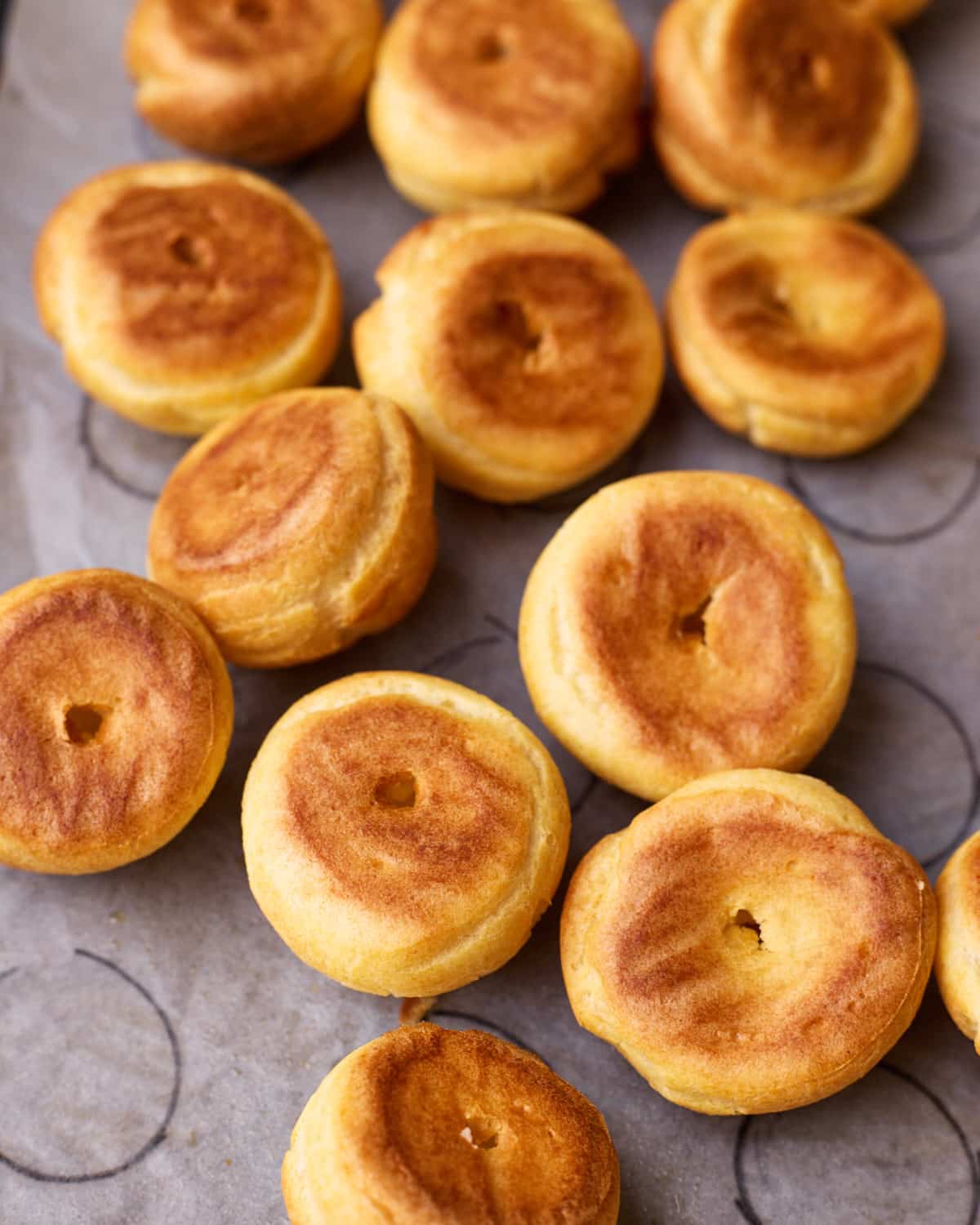
Know when it's fully baked: When choux is done, it will:
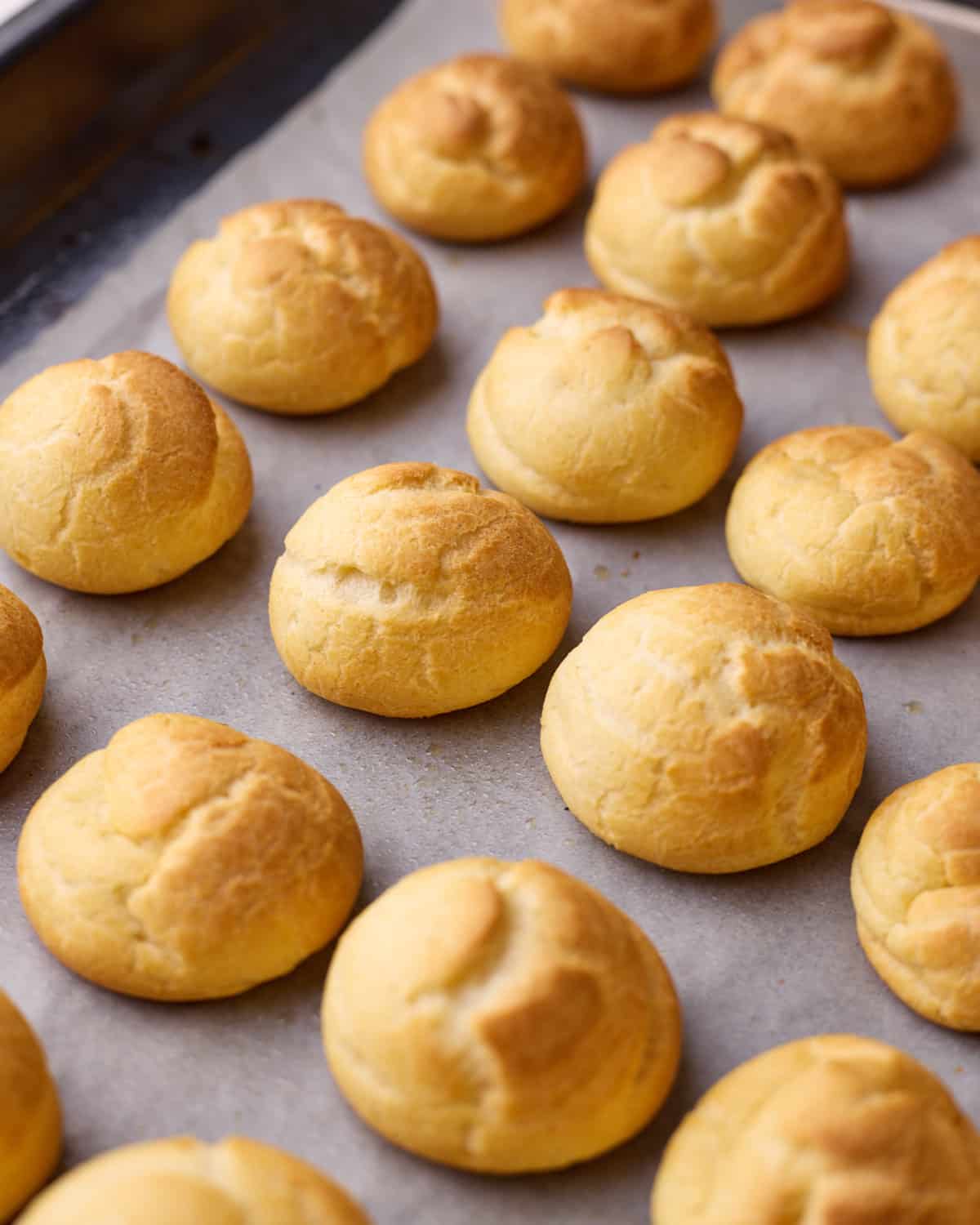
- Be deeply golden brown all over (darker than you expect).
- Feel light for its size
- Sound hollow when tapped
Dry the shells after baking: Turn the oven off and leave the door slightly open for 10-15 minutes to let steam escape. For bigger choux buns, you can also pierce the base to release steam and prevent sogginess.
The Most Important Things To Get Right
In case you don't want to read the whole post, here is a summary of the most important things to pay attention to when making choux pastry:
- Weigh your ingredients - use a kitchen scale so you can measure ingredients accurately and keep the right ratios.
- Cook the panade properly - keep cooking until a smooth ball forms, and you can see a thin film on the bottom of the pan.
- Cool the dough before adding eggs - if it's too hot, the eggs can scramble.
- Add eggs by texture, not quantity - stop when the dough is smooth, glossy, and falls in a V-shape.
- Do NOT open the oven door early - the hot steam will escape, and the beautifully puffed shells will collapse. I've done it - it's very sad.
Troubleshooting
Here are some of the most common issues when making pâte à choux. And yes, I have made every one of these mistakes!
- Pastry is too stiff: needs more egg - add gradually until smooth, glossy, and falling in a thick V.
- Pastry is lumpy: eggs were added while the dough was too hot, and they scrambled.
- Pastry is runny: the panade was undercooked, or too much egg was added.
- Shells don't rise: the dough is too wet, or the oven is not hot enough.
- Shells collapse after baking: taken out before fully set, or the oven was opened too early.
- Shells aren't hollow: not enough steam from the dough being too dry or stiff.
Storage + Make Ahead
Unbaked choux dough can be covered and refrigerated for up to 2 days. Bring it to room temperature before piping.
Baked puffs can be stored in an airtight container overnight or frozen for 3 months. Re-crisp them in the oven for 10 minutes before filling.
Filled choux pastries are best enjoyed within a few hours, as the filling can make the pastry go soggy.
What To Make With Choux Pastry
Once you've mastered the process of making choux, there are a lot of tasty things you can make with it:
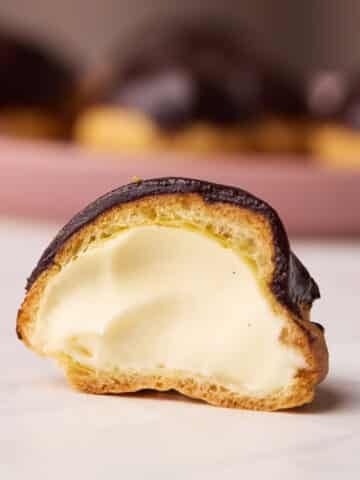
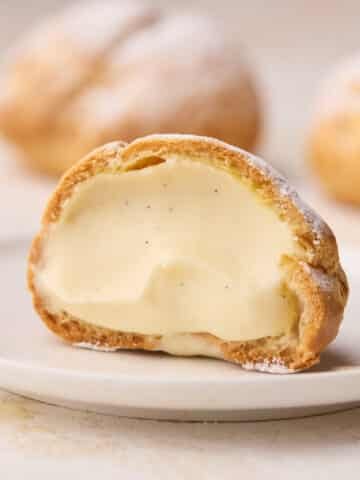
- Cream Puffs
- Profiteroles
- Éclairs
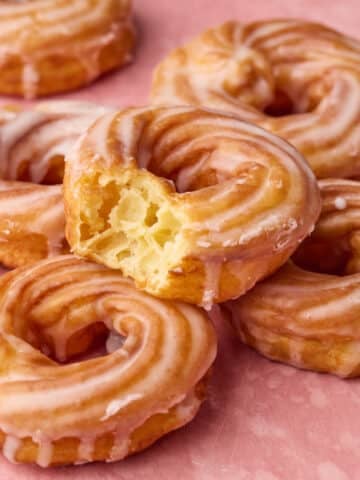
- French Crullers
- Churros
- Paris-Brest
- Gougères
Best Fillings for Choux Pastries
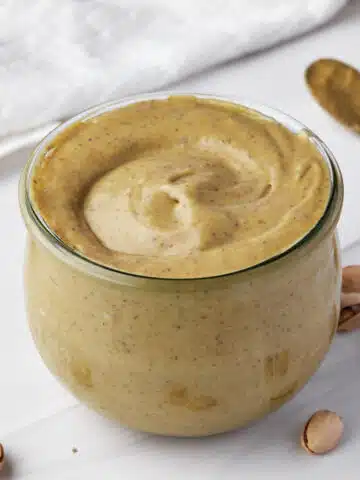
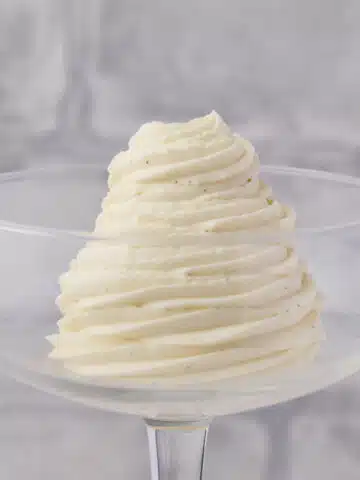
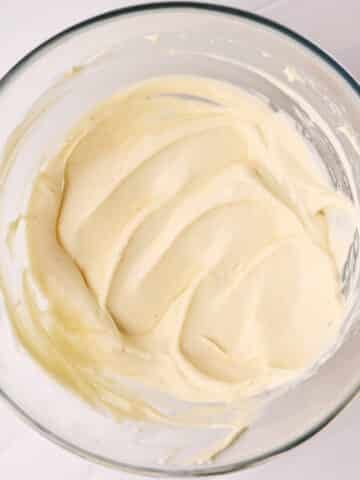
You can fill your choux buns with anything you fancy, but these are some of my favorite choux filling ideas:
FAQ
If you have a question about choux pastry that isn't answered in the post, please leave it in the comments below and I will get back to you as soon as possible.
Yes, you can freeze both raw choux pastry and baked choux shells for up to 3 months. Re-crisp baked shells in the oven after thawing.
There are many desserts you can make with a basic choux dough, from filled choux buns like profiteroles and cream puffs, to eclairs and Paris Brest. You can also deep fry choux pastry to make French crullers and churros.
Classic fillings for choux pastry shells are:
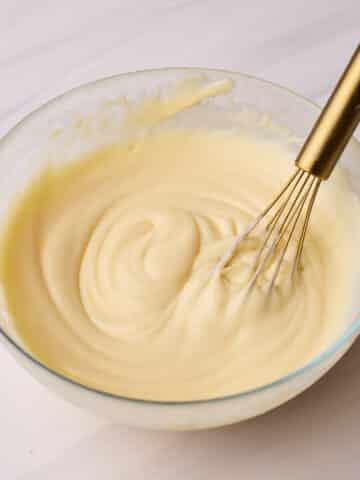
- Pastry cream
- Chantilly cream
- Creme diplomat
- Ice cream
'Choux' is the French word for 'cabbages'; choux gets its name because baked choux buns look like tiny cabbages.
Show Me Your Bakes!
If you tried this recipe, I'd love to know how it turned out in the comments!
Want to share a photo? You can send me a pic or tag @bonni_bakery on Instagram - I love seeing all your creations.
Watch Me Make Choux (Video)
Watch me make choux pastry dough and turn it into delicious French Crullers in this video:
More Pastry Recipes

Choux Pastry Recipe (Pâte à Choux)
Ingredients
- 113 g (1 stick) Unsalted Butter
- 120 ml (½ cup) Milk
- 120 ml (½ cup) Water
- 2 teaspoon Granulated Sugar (caster sugar)
- ¼ teaspoon Salt
- 130 g (1 cup + 1 tbsp) All-purpose Flour (plain flour) sifted
- 5-6 Large Eggs (medium eggs in the UK) *see notes
Equipment
- Wooden Spoon or Spatula
- Stand Mixer with Paddle Attachment
Instructions
- Add all the ingredients except the flour and eggs to a saucepan over medium heat. Stir together until the butter has melted and the mixture starts to boil.113 g (1 stick) Unsalted Butter, 120 ml (½ cup) Milk, 120 ml (½ cup) Water, 2 tsp Granulated Sugar, ¼ tsp Salt
- As soon as the mixture is boiling, remove it from the heat and quickly add all of the sifted flour. Mix quickly with a wooden spoon until the flour is totally incorporated.130 g (1 cup + 1 tbsp) All-purpose Flour
- Return the pan to the heat and continue to beat it vigorously for 2-4 minutes until it comes together into a smooth, shiny ball and you can see a thin film on the bottom of the pan. If you are not confident that it is cooked enough, you can check the temperature - it needs to get to between 165-175°F (74-79°C)
- Transfer the dough to the bowl of a stand mixer and use your spoon to spread it up the sides of the bowl to help it cool faster. Leave to cool for at least 10 minutes until it is no longer hot to touch.
- Turn the stand mixer on low speed with a paddle attachment fitted. Add the eggs one at a time, letting them mix until completely incorporated in between each egg until you have one egg remaining. The amount of egg needed varies according to multiple factors, so you may not need all of the eggs to reach the right consistency.5-6 Large Eggs
- Crack the last egg into a bowl and beat it with a fork to break it apart. Add it to the mixer a little at a time, testing the pastry in between to see if is ready. You are aiming for a paste-like dough that is smooth, glossy, and pipeable. You can test if it is ready by putting a spatula into the bowl and lifting it out - if the dough is the right consistency, it will fall off the spatula in a V-shape. See the post above for more tips on how to know exactly when it's ready. Once the right consistency is reached, do not add any more eggs.
- Transfer the choux pastry to a piping bag with a round tip or star tip, depending on what kind of choux shells you are making. Squeeze any air bubbles out of the bag.
- Pipe a tiny amount of pastry into the four corners of a baking sheet and line it with parchment paper. This holds the paper in place as you pipe.
- For choux buns:Hold the piping bag at a 90° angle to the pan, squeeze steadily while holding the tip of the bag just slightly under the surface of the pastry to make little mounds of pastry on the sheet. For eclairs:Hold the bag at a 45° angle and apply even pressure as you draw a line on the tray. Try to make them the same thickness all the way down.You can use a printed guide underneath the the parchment paper to help get consistent sizing.
- Stop squeezing before moving your piping bag away, and flick your wrist to break the flow of the pastry. Make sure to leave plenty of space in between each one as they will puff up a lot as they bake.
- Dip your finger in a little cold water and gently dab down the little peaks to flatten them. Let the piped choux sit on the baking sheet for 10 minutes while you preheat the oven.
- How you bake choux pastry depends on what kind of choux shells you are making. See the individual recipe posts for guidance on each one. I have included the instructions for medium choux buns here as a reference point. Important: Bake time varies massively depending on size, shape, and moisture content - so it's best to learn the signs that your choux pastry is baked, rather than relying on arbitrary recipe times. See the post above for more information on this.
- For medium choux buns, preheat the oven to 400°F / 200°C (180° fan-assisted). Bake the choux at this temperature for 10-12 minutes until they have risen.
- Once the buns have puffed up, turn the temperature down to 375°F / 190°C (170° fan-assisted) and bake for a further 25 - 35 minutes, or until the buns are golden brown all over and fully baked. Do not open the oven door in the first 20 minutes or the shells will collapse!
- Remove them from the oven and turn the oven off. Pierce a hole in the bottom of each choux bun with a skewer to let steam escape, then place them back on the sheet, hole-side-up and put back in the switched off oven with the door propped open to allow them to dry out for 15 minutes.
- Remove from the oven and let them cool completely on a wire rack before filling.
Nutrition
Notes
Most Important Tips for Choux Success:
- Weigh your ingredients: Choux pastry is all about ratios. You can't measure accurately with cups, so I strongly recommend using a kitchen scale to weigh your ingredients.
- Cook the panade properly - After adding the flour, make sure you keep cooking until a smooth ball forms, and you can see a thin film on the bottom of the pan. It's crucial that you cook enough moisture out of the dough to prevent flat choux buns.
- Cool the hot dough before adding the eggs so the heat doesn't cook or scramble the eggs. You put the dough in your mixer bowl and spread it up the sides to cool it down faster.
- Judge the amount of egg by consistency - every time you make choux pastry dough, it will need a slightly different amount of egg. Learn to know when it has reached the right consistency using the guide above.
- Pipe steadily, holding your pastry bag at a 90° angle to the baking tray, apply steady, even pressure, and try to keep the sizes consistent.
- Rest the dough for 10-15 minutes after piping and before baking. Even better if you can chill it.
- Spray with water - Use a spray bottle to give the choux and parchment paper a fine mist of water just before baking, to encourage steam and help them to puff up evenly.
- Don't open the oven door - if you take the choux out too early or open the oven door before they have fully set, they will collapse.


Shirley says
So easy, taste so good