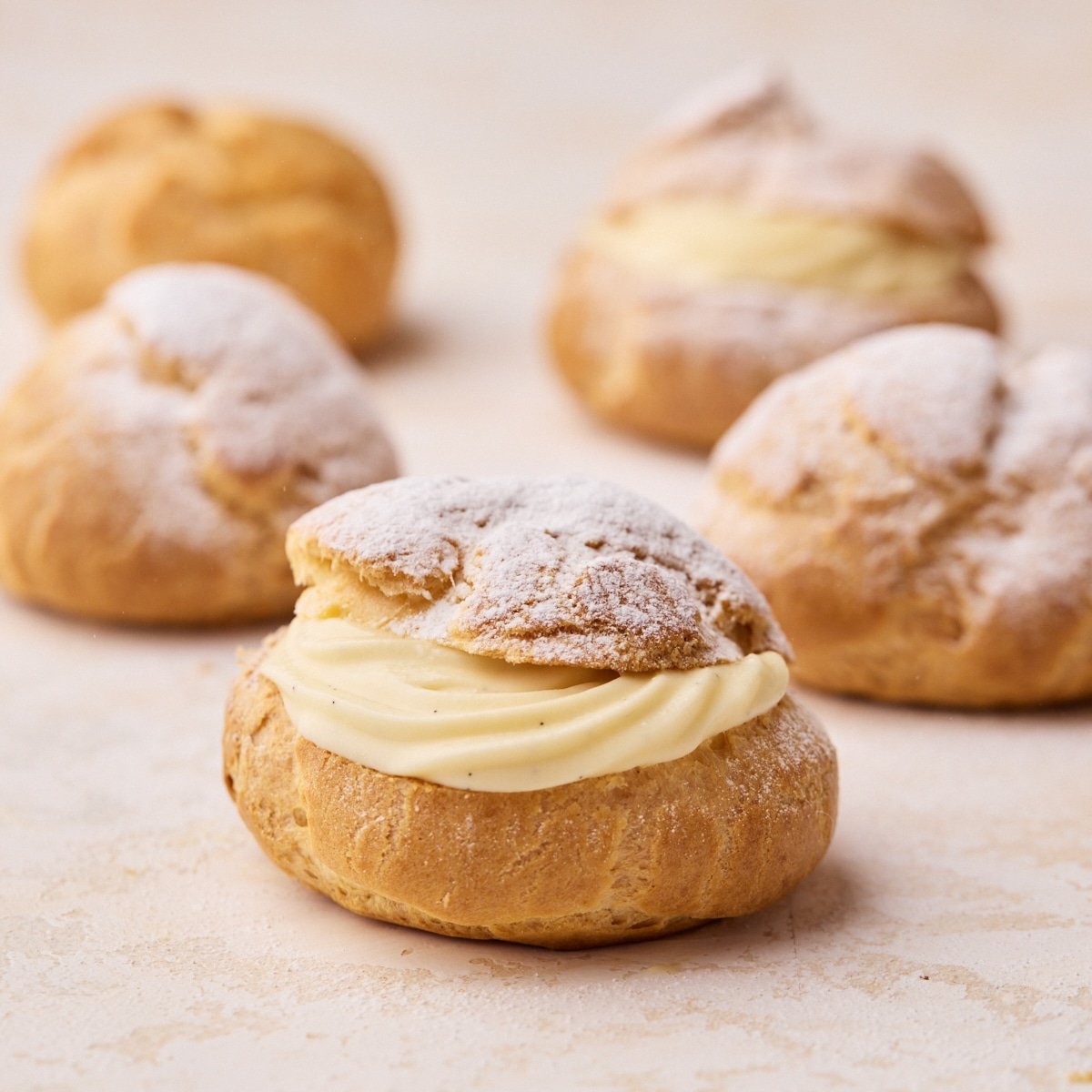

Choux Pastry Recipe (Pâte à Choux)
How to make light and crisp choux pastry for eclairs, cream puffs, profiteroles, and more.
Servings: 24 medium choux buns
Ingredients
- 1 stick Unsalted Butter 113g
- ½ cup Milk 120ml
- ½ cup Water 120ml
- 2 teaspoon Granulated Sugar
- ¼ teaspoon Salt
- 1 cup + 1 tbsp All-purpose Flour 130g (sifted)
- 5-6 Large Eggs (room temperature) *see notes
Instructions
How To Make Choux Pastry
- Add all the ingredients except the flour and eggs to a saucepan over medium heat. Stir together until the butter has melted and the mixture starts to boil.
- As soon as the mixture is boiling, remove it from the heat and quickly add all of the sifted flour. Mix quickly with a wooden spoon until the flour is totally incorporated.
- Return the pan to the heat and continue to beat it vigorously for 2-4 minutes until it comes together into a smooth, shiny ball and you can see a thin film on the bottom of the pan. If you are not confident that it is cooked enough, you can check the temperature - it needs to get to between 165-175°F (74-79°C)
- Transfer the dough to the bowl of a stand mixer and use your spoon to spread it up the sides of the bowl to help it cool faster. Leave to cool for at least 10 minutes until it is no longer hot to touch.
- Turn the stand mixer on low speed with a paddle attachment fitted. Add the eggs one at a time, letting them mix until completely incorporated in between each egg until you have one egg remaining. The amount of egg needed varies according to multiple factors, so you may not need all of the eggs to reach the right consistency.
- Crack the last egg into a bowl and beat it with a fork to break it apart. Add it to the mixer a little at a time, testing the pastry in between to see if is ready. You are aiming for a paste-like dough that is smooth, glossy, and pipeable. You can test if it is ready by putting a spatula into the bowl and lifting it out - if the dough is the right consistency, it will fall off the spatula in a V-shape. See the post above for more tips on how to know exactly when it's ready. Once the right consistency is reached, do not add any more eggs.
How To Pipe Choux Pastry
- Transfer the choux pastry to a piping bag with a round tip or star tip, depending on what kind of choux shells you are making. Squeeze any air bubbles out of the bag.
- Pipe a tiny amount of pastry into the four corners of a baking sheet and line it with parchment paper. This holds the paper in place as you pipe.
- For choux buns:Hold the piping bag at a 90° angle to the pan, squeeze steadily while holding the tip of the bag just slightly under the surface of the pastry to make little mounds of pastry on the sheet. For eclairs:Hold the bag at a 45° angle and apply even pressure as you draw a line on the tray. Try to make them the same thickness all the way down.You can use a printed guide underneath the the parchment paper to help get consistent sizing.
- Stop squeezing before moving your piping bag away, and flick your wrist to break the flow of the pastry. Make sure to leave plenty of space in between each one as they will puff up a lot as they bake.
- Dip your finger in a little cold water and gently dab down the little peaks to flatten them. Let the piped choux sit on the baking sheet for 10 minutes while you preheat the oven.
How To Bake Choux
- How you bake choux pastry depends on what kind of choux shells you are making. See the individual recipe posts for guidance on each one. I have included the instructions for medium choux buns here as a reference point. Important: Bake time varies massively depending on size, shape, and moisture content - so it's best to learn the signs that your choux pastry is baked, rather than relying on arbitrary recipe times. See the post above for more information on this.
- For medium choux buns, preheat the oven to 400°F / 200°C (180° fan-assisted). Bake the choux at this temperature for 10-12 minutes until they have risen.
- Once the buns have puffed up, turn the temperature down to 375°F / 190°C (170° fan-assisted) and bake for a further 25 - 35 minutes, or until the buns are golden brown all over and fully baked. Do not open the oven door in the first 20 minutes or the shells will collapse!
- Remove them from the oven and turn the oven off. Pierce a hole in the bottom of each choux bun with a skewer to let steam escape, then place them back on the sheet, hole-side-up and put back in the switched off oven with the door propped open to allow them to dry out for 15 minutes.
- Remove from the oven and let them cool completely on a wire rack before filling.
Notes
Most Important Tips for Choux Success:
- Cook the panade properly - After adding the flour, make sure you keep cooking until a smooth ball forms, and you can see a thin film on the bottom of the pan. It's crucial that you cook enough moisture out of the dough to prevent flat choux buns.
- Cool the hot dough before adding the eggs so the heat doesn't cook or scramble the eggs. You put the dough in your mixer bowl and spread it up the sides to cool it down faster.
- Judge the amount of egg by consistency - every time you make choux pastry dough, it will need a slightly different amount of egg. Learn to know when it has reached the right consistency using the guide above.
- Pipe steadily, holding your pastry bag at a 90° angle to the baking tray, apply steady, even pressure, and try to keep the sizes consistent.
- Rest the dough for 10-15 minutes after piping and before baking. Even better if you can chill it.
- Spray with water - Use a spray bottle to give the choux and parchment paper a fine mist of water just before baking, to encourage steam and help them to puff up evenly.
- Don't open the oven door - if you take the choux out too early or open the oven door before they have fully set, they will collapse.