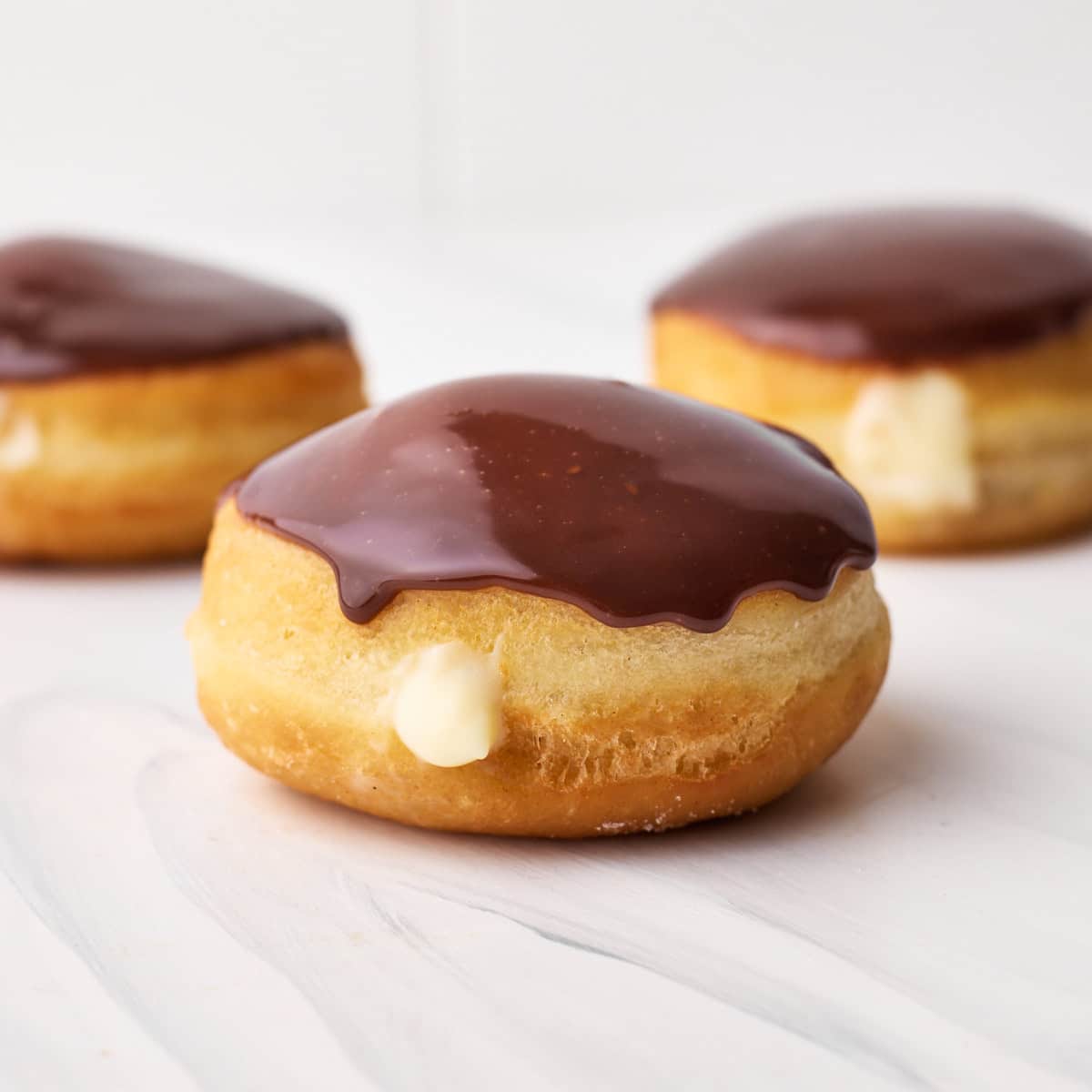

Boston Cream Donut Recipe
Homemade fried donuts filled with pastry cream and topped with chocolate ganache.
Servings: 18 donuts
Ingredients
For the Pastry Cream Filling
- 5 (3) Large Egg Yolks
- 100 g (½ cup) Granulated Sugar, (Caster sugar)
- 480 ml (2 cups) Whole Milk
- 20 g (2½ tablespoon) Cornstarch
- 2 teaspoon (2 teaspoon) Vanilla Extract
- 30 g (2 tablespoon) Unsalted Butter
- ¼ teaspoon (¼ teaspoon) Salt
For the Donuts
- 600 g (5 cups) All-purpose Flour, (Plain flour)
- 100 g (½ cup) Granulated Sugar, (Caster sugar)
- 14 g (4½ teaspoon) Active Dry Yeast, two 7g packets
- 240 ml (1 cup) Whole Milk
- 2 (2) Large Eggs
- 75 g (⅔ stick) Unsalted Butter, melted and cooled
- 1 teaspoon (1 teaspoon) Salt
- Neutral Frying Oil, enough to fill the pan at least 2 inches
For the Chocolate Glaze
- 225 g (8 oz) Semi-sweet Chocolate, chopped
- 120 ml (½ cup) Heavy Cream
Instructions
Make the Pastry Cream
- Note: Make the pastry cream filling ahead of time, at least two hours before it is needed so it has time to chill. For more in-depth instructions and step-by-step process shots, see my post on how to make pastry cream.
- Whisk the egg yolks together with the cornstarch and sugar until pale and thick.
- Pour the milk into a saucepan and heat over medium heat until scalding hot (this means steam is rising and tiny bubbles are appearing on the surface).
- Slowly drizzle the hot milk into the whisked egg yolk mixture, whisking as you go. Do this slowly so the temperature of the eggs rises gradually, avoiding scrambling.
- Pour everything back into the pan and cook, whisking constantly, until it thickens and starts to boil. Keep whisking gently and let it boil for 1-2 minutes to fully activate the cornstarch.
- Remove from the heat and pass the pastry cream through a fine mesh sieve to remove any lumps.
- Stir in the vanilla, salt, and butter.
- Cover with plastic wrap, so the plastic is touching the surface of the pastry cream, and let cool. Then refrigerate until needed (at least 2 hours).
Make the Donut Dough
- Warm the milk to lukewarm temperature and mix in the active dry yeast and 1 tablespoon of the sugar. Let it sit for 5-10 minutes or until it starts to froth up.If you are using instant yeast, you can skip this step and add your yeast with the flour later.
- In the bowl of a stand mixer with a dough hook attachment, add the remaining sugar, salt, and eggs. Pour the activated yeast/milk mixture in and stir everything to combine.
- Add the flour and turn the mixer on low speed for 1 minute until it incorporates slightly, then slowly drizzle in the melted butter.
- Turn the mixer up to medium speed and let it mix for about 5 minutes or until the dough looks smooth and is pulling away from the sides of the bowl.If it seems too wet, you can add an extra tablespoon of flour and knead for a bit longer.
- Tip your dough out onto a floured work surface and knead by hand for a couple of minutes until it is smooth, elastic, and no longer sticking to your hands.Use the windowpane test to check if it has been kneaded enough; take a small piece of dough and stretch it out thinly with your fingers. If you can stretch it out thin enough to see light through it without it tearing, it's ready. (See image in the post above for an example).
- Form a smooth ball with the dough and place it into a lightly greased bowl. Cover with plastic wrap and let proof on the counter until it doubles in size (about 1-2 hours, depending on temperature).
- Once the dough has doubled in size, check if it is ready by pressing on it lightly with your finger. If the indent disappears immediately, it needs longer to prove. If the indent comes back slowly and only about halfway, then it is ready to use.
- Give the dough a satisfying punch in the centre to release the built-up gas. Tip it onto a lightly floured work surface and gently press out any large air pockets, then roll it to approximately ½ inch thick.
- Cut rounds out of the dough with a cookie cutter that is 2½ - 3 inches wide. Press straight down with the cutter, don't twist it - this will help them to rise tall. Place each donut on a little square of parchment paper, on a cookie sheet, with a little space between them.You can re-roll and cut out the scraps, but I don't recommend doing it more than once as it can make the donuts tough.
- Cover the donuts loosely with plastic wrap or a kitchen towel and leave to prove again for roughly 45 minutes. Do the indent test again to see if they are ready. If not, check them again at 15-minute intervals.
Fry the Donuts
- Once the donuts are ready, uncover them and start preheating the oil to 340°F / 175°C.Make sure the oil in your pan is at least 2-3 inches deep.
- Use the parchment paper squares to gently lower your donuts into the oil, they should start bubbling at the sides. It's best to just fry 2 or 3 donuts at a time.Let the donuts bob around and fry for a minute or two, checking the underside from time to time. Once the underside looks golden brown, flip the donut and fry the other side until the color matches.As there are so many variables (oil temperature, donut size, etc), it is impossible to give you an exact time to fry the donuts for - you really have to do it by eye and see when they look ready.Once both sides are golden brown, scoop the donuts out with a heatproof slotted spoon and lay them on a wire rack lined with paper towels to soak up the excess oil.
- Let the donuts cool completely before filling and glazing.
The oil temperature will fluctuate as you go, I have found the best results for this recipe while keeping the oil temp between 325°-340°F (165°-171°C). Make sure you let the oil come back up to temperature in between batches, as it will cool down as you are frying.
Make the Glaze
- Make the ganache glaze right before you fill the donuts so it has time to cool slightly and will be ready to dip the filled donuts into. Heat the cream in a saucepan until it is steaming but not boiling, then pour over the chopped chocolate and let sit for 1 minute.
- Stir the chocolate and cream until all the chocolate has melted and the ganache is smooth and glossy.
Fill the Donuts
- Take the pastry cream out of the fridge, whisk it a little to bring the texture back, and then transfer it to a piping bag with any kind of tip.
- Use a long, thin object like a chopstick or a metal straw to poke a hole in the side of each donut and move it around to create space in the middle.
- Gently squeeze a generous amount of pastry cream into each donut. Once the donut feels heavy, you will know it is full.
- Dip each filled donut into the chocolate ganache, shake gently to get rid of any excess, and set them down on a baking sheet to set.
Notes
Frying Temperature
Many recipes will tell you that the optimal temperature for frying donuts is 375°F. I have tested frying these donuts at various temperatures, and I consistently find that 325° - 340° is the best temperature to fry them at.
Troubleshooting
I have a whole troubleshooting section in the blog post above for common mistakes and questions.